Food Systems Podcast 107
Interview with Janez Potočnik
Wednesday, Sep 30, 2026
As the Forum for the Future of Agriculture moves towards its 20th anniversary, the latest Food Systems Podcast provides an opportunity to reflect on how both the Forum and the wider food and agriculture landscape have changed – and what needs to happen next.
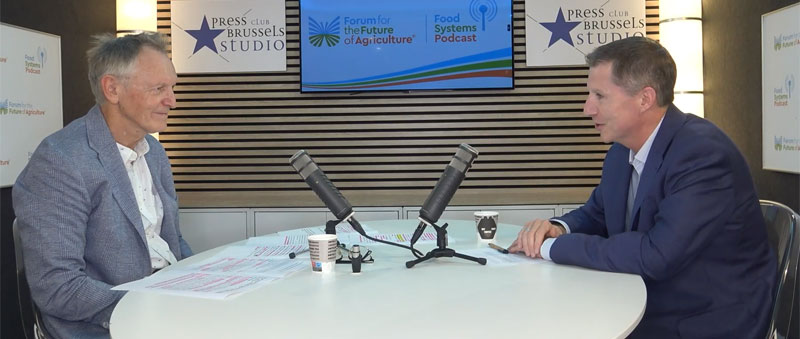
Mark Titterington is joined by long-serving Forum Chairman Janez Potočnik for a wide-ranging conversation about the challenges facing agriculture, food systems, Europe and the international community. Their discussion considers how the Forum itself should evolve, while exploring some of the bigger forces shaping its agenda: geopolitical uncertainty, climate change, the growing importance of food and water security, financing the transition, natural-resource constraints and the need for greater resilience.
A recurring theme is the need to move beyond identifying problems and discussing solutions towards creating the conditions for meaningful change at scale. Potočnik argues that cooperation remains essential in an increasingly interconnected world, but that overcoming short-term thinking will be critical if societies are to address longer-term environmental and economic risks.
Looking ahead to the Forum’s 20th anniversary conference in 2027, the conversation also considers a renewed Call to Action and the opportunity for the Forum to combine its established role as a platform for dialogue with a stronger emphasis on practical commitments and action.
The following summary brings together the key questions raised by Mark Titterington and the main points from Janez Potočnik’s responses.
As the Forum for the Future of Agriculture reaches its 20th anniversary and faces a changing set of challenges, does it need to change, evolve and do things differently?
Janez answers both “no and yes.” The Forum’s fundamental approach – dialogue, cooperation and continually adapting its agenda – remains valid. However, the world in which it operates has changed substantially.
He identifies three reasons for evolution. First, geopolitical relations are shifting from a rules-based towards a more power-based world, making it particularly important to retain a compass based on values, rule of law, cooperation and science. Second, climate change is increasingly affecting the relationship between agriculture and the environment. While adaptation is now unavoidable, he warns that adaptation essentially represents the future cost of insufficient mitigation today. Third, dialogue by itself is no longer enough: the Forum needs to translate discussion into more concrete commitments and action.
Mark refers to discussions around the UN General Assembly and New York Climate Week and asks Janez for his reaction to the suggestion that society has given in to a power-based system because collaboration has become too difficult as a means of solving major challenges.
Janez argues that cooperation is not optional. Humanity is the first generation living within a genuinely interconnected, planetary-scale socio-ecological system. Climate change, nuclear weapons, artificial intelligence, trade, pandemics and the internet all cross national borders.
A connected world cannot realistically be governed without cooperation. He challenges the idea that national sovereignty is best protected through isolation: in today’s interconnected world, effective cooperation is itself a way of protecting sovereignty.
With the Forum marking its 20th anniversary and moving its annual conference to a new venue in April 2027, what does Janez expect it to announce, and why is that important?
The centrepiece should be a renewed Call to Action. Discussion alone is no longer sufficient, and the anniversary provides an appropriate moment to move towards more tangible action. He wants the Forum to contribute to — and help connect — the European Commission’s visions for agriculture and the environment, pushing boundaries while encouraging greater cooperation and shared understanding.
The new venue, The EGG, also symbolises renewal: new life, new beginnings and new thinking. The 20th anniversary should therefore be used not simply to look back, but to take a more strategic and open-minded view of the future.
With so many challenges facing food and agriculture, where can the Forum make the greatest impact? Which priorities should it concentrate on and explore in greater depth?
Janez believes the Forum’s core priorities remain broadly correct, but they need to be addressed in more concrete and operational terms. He highlights several areas: financing the transition and reducing its risks; the relationship between public and private finance; the MFF and CAP; regenerative agriculture; the bioeconomy; the food-water-energy-climate nexus; and valuing and accounting for natural capital.
The underlying problem is short-termism. Business leaders recognise that many of their greatest long-term risks are environmental, yet politics, finance and business continue to operate largely around short-term priorities. That disconnect makes the future increasingly unpredictable.
Janez adds that water and food may ultimately become the game changers. Growing insecurity around water — for drinking, agriculture and energy — and its close connection to food security may force these longer-term risks into immediate decision-making.
Although the Forum is rooted in Brussels, why is maintaining and developing its international dimension so important?
Food security, the bioeconomy and environmental challenges are global issues, so Europe cannot develop solutions independently of the rest of the world. Nevertheless, Janez strongly believes the Forum should retain its European focus because Europe has historically provided an important benchmark for longer-term thinking and societal wellbeing, rather than measuring progress solely through GDP.
He points to healthcare, education, democracy, freedom of speech and care for older people as examples of wider societal values. Europe therefore needs to maintain its own direction because other parts of the world continue to watch what Europe does. He also identifies supporting Ukraine’s future transition and integration into the European community, and maintaining transatlantic relationships, as important. In an interconnected world, the Forum cannot discuss these issues within a regional silo.
Picking up on Janez’s comments, Mark asks whether Europe is becoming less aware of — or moving away from — its responsibility to lead on this agenda, despite countries such as India continuing to look towards Europe.
Janez says Europe is at a crossroads. It remains a major economic power and a leader in areas such as international assistance and the circular economy, which means other countries continue to look towards it. However, Europe’s influence depends upon its ability to act collectively. Janez sees insufficient cohesion and argues for a stronger internal market and better alignment in areas including fiscal, foreign and defence policy.
Europe is also particularly vulnerable because it is a net importer of energy and materials. He believes Europe has an opportunity to demonstrate that a developed democratic continent can function successfully within resource constraints. Doing so could restore its leadership as resource constraints become increasingly important globally.
His message is that Europe needs ambition rather than simply complaining about declining influence.
Reflecting on discussions about resilient food systems and geopolitical stability, Mark raises two related problems: money and tools for change already exist but transformation is not happening; and food-system efficiency is still largely measured through productivity and output rather than resilience and long-term sustainability. He therefore asks: What does genuine system change actually mean, and what does it take to scale the solutions that are needed?
Janez argues that existing governmental and institutional structures are largely organised in sectoral silos, which encourages competition between interests rather than collective solutions. For systems change to scale, the conditions surrounding individual solutions must change. He illustrates this with the quote from Brazilian writer Mario Quintana: rather than chasing butterflies, “mend your garden and the butterflies will come.” In other words, instead of continually pursuing isolated solutions, society needs to create the systemic conditions in which those solutions can succeed.
The obstacle is that changing those conditions frequently conflicts with short-term interests within companies, governments and other institutions.
He also stresses that resilience is inherently forward-looking. Genuine resilience requires strategic, systemic, long-term thinking rather than reacting repeatedly to immediate crises.
Given a world characterised by unforeseen shocks, Mark asks Janez whether he can remain optimistic while still being realistic about what is possible.
Janez acknowledges that it is increasingly difficult to be both science-based and optimistic, pointing to unusually high temperatures in Brussels at the beginning of October as a visible reminder of the reality of climate change. Nevertheless, he sees grounds for optimism in what has already been achieved. Through the Forum alone, tens of thousands of stakeholders have been engaged over its 20-year history, demonstrating that progress and mobilisation are possible.
He cites Slovenian philosopher Slavoj Žižek’s idea that difficult and unpredictable periods provide reasons for pessimism but can simultaneously create opportunities for significant change.
Janez ultimately chooses optimism as a personal and practical position: optimists are the people who help change the world for the better.
The overall thread
Across Mark’s eight substantive questions, Janez returns repeatedly to one central argument: the challenge is no longer primarily identifying what needs to change; it is creating the conditions that allow change to happen at scale.
That connects the Forum’s proposed renewed Call to Action with financing the transition, cooperation, Europe’s role, natural-resource constraints, food and water security, resilience and systems transformation. The 20th anniversary is therefore presented not simply as a celebration of what the Forum has achieved, but as an opportunity to shift from dialogue towards more concrete action, while retaining the cooperative approach on which the Forum was founded.
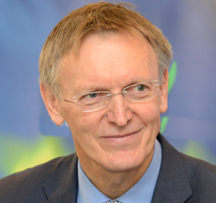
Janez Potočnik
Dr Janez Potočnik graduated from the Faculty of Economics at the University of Ljubljana, Slovenia. After a successful career...see more
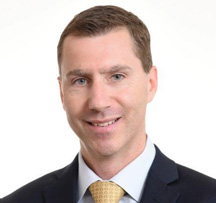
Mark Titterington
Mark is a Co-founder and a former Director of the Forum for the Future of Agriculture. He is now...see more