

2026 Annual Conference – Inspirational talk – At the edge of the World: Lessons from Antarctic exploration and extreme conditions
Tuesday, Apr 14, 2026
Antarctica has a way of shrinking human ambition to its proper size – that was the message from Henri de Gerlache, Belgian explorer, filmmaker, and great-grandson of the pioneering polar explorer Adrien de Gerlache, brought to the Forum in his inspirational talk followed by a conversation with Mark Titterington.
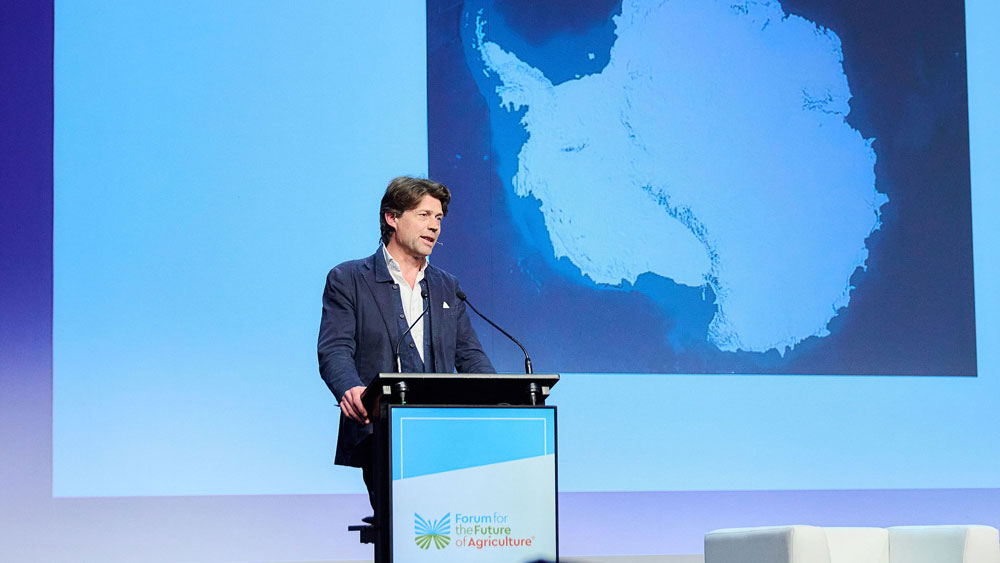
Mr De Gerlache has visited Antarctica three times, including an ascent of Mount Vinson, at 5,140 metres the continent’s highest peak. He is currently preparing a documentary series on the heroic age of polar exploration. His talk took the audience from adventure to what Antarctica reveals about nature, about limits, and about humility.
“Because in those frozen expanses, everything reminds us of human fragility. The cold, a force that seeps in, exhausts and destroys. The wind, capable of erasing tracks, disorienting, isolating. And the silence, immense and almost oppressive,” he said.
The great explorers of the early 20th Century set out to plant flags and trace routes. “Very quickly, Antarctica imposed its own rules,” said Mr de Gerlache. “It slowed them, blocked them, broke them.” The Antarctic Treaty of 1959 dedicated an entire continent to peace and scientific research and a rare collective acknowledgement that some limits must be respected.
What Antarctica is telling us
Today, scientists from across the world live and work there, not to conquer the continent, but to listen to it, he said. “Antarctica is now speaking and what it tells us is deeply concerning. Sea level rise, for instance, depends on what is happening in Antarctica.” The history of Antarctic exploration can be seen as a journey from ignorance to knowledge, from audacity to mastery. But another view is that it is a slow learning of humility.
“At every stage, the history reminds us that nature is not a backdrop. It is not merely a setting in which humanity evolves freely. It’s a force, a complex system, upon which we entirely depend. Where humanity believed it could impose itself, it had to adapt.”
Mr de Gerlache concluded: “If these icy lands, so long perceived as a desert, have something to teach us, it may be this: that the greatness of humanity lies not in its ability to dominate nature, but in its capacity to respect it.”
Cooperation as survival
Asked by Mark Titterington about the power of collaboration, Mr de Gerlache replied that in Antarctica, cooperation is not optional: “If you are alone there, you are almost dead.” He highlighted Amundsen – the first to reach the South Pole, in December 1911 – as the explorer who understood this most clearly. Amundsen learned from the Inuit, travelling light, working with the ice rather than against it.
And what gives him hope, Mark asked? The answer was that spirit of enforced collaboration across nations and across disciplines. He hoped the Antarctic Treaty would be renewed in 2040, because what it represents – nationalities obliged to collaborate to survive – may become a model not just for one continent, but for the planet.