

2026 Annual Conference – Session 1: The end of the world as we know it – what are the consequences for agriculture and environment?
Tuesday, Apr 14, 2026
What does “the end of the world as we know it” mean for agriculture and the environment – and how do we respond to the challenges? Panellists brought diverse perspectives in the first panel, moderated by Stephen Sackur.
“Focus on innovation and the long-term”
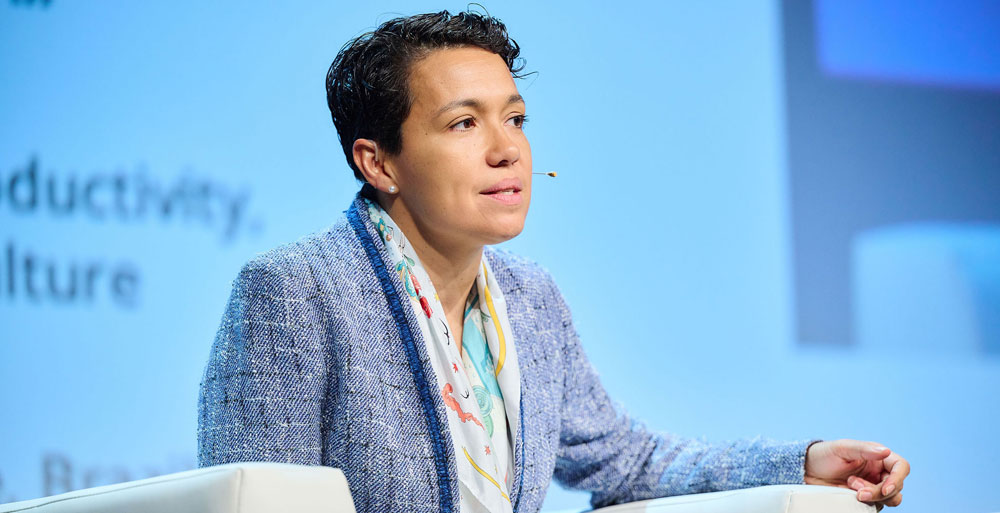
“We’ve been facing the end of the world as we know it for quite some time now from a climate perspective,” said Cristina Bruce, Senior Vice President, Sustainability and Social Impact, Anglo American. Her sector is already taking the long-term view: in mining, a project typically takes 17 years from discovery to production. Anglo American is developing the world’s largest deposit of polyhalite, based in northern England, to produce innovative, low-carbon fertilizer products. The company is also divesting from thermal coal and reshaping its portfolio around copper, iron ore and polyhalite.
“We need a focus on supporting innovation, supporting companies that are looking to the long term – working with customers and regulators to develop systems resilience and sustainability,” she said.
“An over-financialised economic system”
Sandrine Dixson-Declève, Global Ambassador for The Club of Rome and Executive Chair, Earth4All, said a main point was that “we’ve been here before”. The Club of Rome has brought systemic solutions to the European Commission following the COVID pandemic and again after the Russian invasion of Ukraine. These included proposing that Europe diversify energy supply, invest in renewables, address energy efficiency, reduce dependencies and build resilience.
“Now, we are seeing a plethora of knee-jerk reactions in the area of defence… and in the risk of not thinking long term,” she said. The core issue was an over-financialised economic system – transactional, rooted in rentierism, and indifferent to equitable distribution of wealth.
Europe needs to innovate, she agreed: invest in rural communities, forge a genuine partnership with Africa as a food production partner, and pursue a green-social-climate friendly deal.

Positive legacy of Europe’s actions
Has Europe been “too busy defending the status quo and not thinking radical thoughts about the future?” That was the question Stephen put to Tassos Haniotis, Special Advisor for Sustainable Productivity, Forum for the Future of Agriculture.
Mr Haniotis spoke from the perspective of many years in DG AGRI: he started with the 2003 reform – “a real break with the past where we saw the positive effects for years.” It positioned farmers as entrepreneurs: reversing the downward trend in farm income, generating strong growth in the agricultural trade balance, and reducing agricultural emissions – the only major agricultural sector in the world to have achieved this.
But there are continuing issues: less of a focus on analysis and impact assessments; farmers making combined economic-environmental decisions when policy treats them separately. And data – private companies generate vast amounts of data and these could be pooled through a public platform.
Three major changes define the new landscape, he concluded: trade no longer operates within a predictable framework; the ambition of the climate agenda has been pushed to unrealistic levels and is now swinging to the other extreme; and public trust in science is eroding.

A “micro green revolution”
Mariangela Hungria, the World Food Prize 2025 laureate – awarded for her work in biological means of fixing nitrogen in soils – joined by live video link from Brazil. “Are we living through a watershed moment?” Stephen asked her.
She drew a parallel with the Green Revolution, arguing that today the world needs a “micro green revolution” – a transformation of agriculture through biologicals. Many microorganisms can partially or fully replace synthetic fertilizers, and the world is not yet taking sufficient advantage of this.
Ms Hungria gave the example of Brazil’s soybean sector, which now relies entirely on biological nitrogen fixation. In the last crop season alone, this saved Brazil an estimated $26 billion in fertilizer costs and avoided 260 million tonnes of CO₂-equivalent emissions. One factor is vitally important: biological solutions do maintain yields, she said.

Missing out on science’s opportunities
The discussion turned to whether Europe is taking advantage of the opportunities offered by science. Sandrine Dixson-Declève highlighted satellite technology as a prime example of science connecting the digital and green transitions in ways that could directly help farmers. She emphasised how much untapped potential exists for joining up agricultural production methods, and land use for food, forestry and fibre. “Why are we not seizing these opportunities… and using this as the moment to shift – because we have the solution,” she said.
Stephen went further: Is Europe particularly slow in encouraging R&D and innovation, given its complex multi-state regulatory environment, he asked. Ms Dixson-Declève said the answer was not deregulation but better regulation – sound, agile and flexible enough to support companies moving in the right direction, while not abandoning impact assessments. She was concerned about existing frameworks being weakened and the lack of the fifth freedom – free movement of research, knowledge and innovation across member states. And Europe risked allowing American-style short-termism to erode its own foundation of values and science.
“It is not just about the dollar – but about value”
Cristina Bruce returned to the question of navigating change. In her world, there has been a real shift in how sustainability needs to be argued: the language has to be about value – for the business, for the stakeholders, and for communities around operations. Short-termism that destroys trust or community wellbeing is not compatible with long-term success. “It is not just about the dollar,” she said, “but we have to be successful businesses. Partnership is a key piece of that.”
Tassos Haniotis agreed that Europe should learn from others without losing confidence in what it does well. Europe urgently needs to find common denominators – on soil health, for example, agreeing on a handful of core indicators. The space for independent analysis and individual expert contributions to policy had narrowed sharply, and this is a serious loss.
Who will invest without billion-dollar returns?
Mariangela Hungria identified profit as the central structural problem. Science produces solutions, but without a private partner willing to bring them to market, they do not reach farmers. The biological inputs sector generates far lower margins than the chemical inputs industry: even where solutions for small farmers exist, they go unused because no company has sufficient incentive to deliver them. Who, she asked, will invest in technologies that improve soil health when there is no prospect of billion-dollar returns? The answer requires new models – potentially involving governments – to bridge the gap between what science knows and what farmers receive.