

2026 Annual Conference – Inspirational talk – Why food connects all the dots
Tuesday, Apr 14, 2026
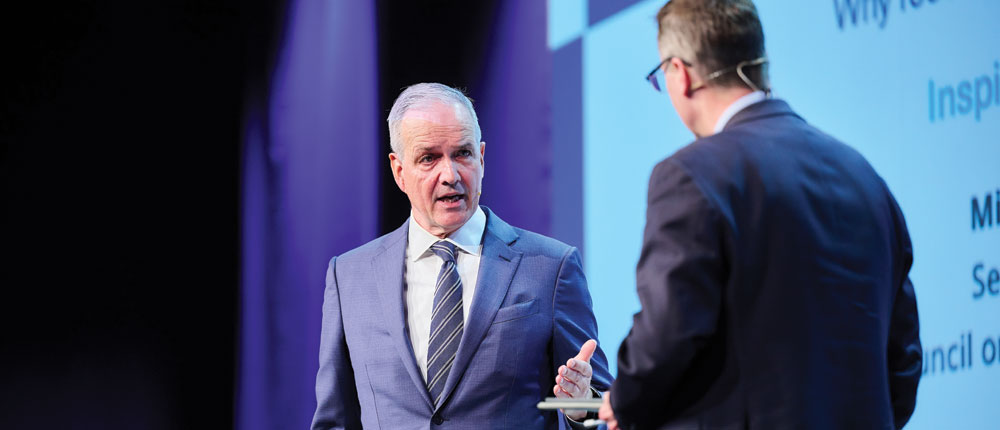
How do we reframe the concept of food security and tackle the “weaponization” of food? This was the theme of Michael Werz’s inspirational talk and subsequent discussion with Mark Titterington, Co-founder and member of the Forum’s Advisory Council.

Mr Werz, Senior Fellow at the Council on Foreign Relations, “works at that nexus between food security, climate, migration, and emerging countries,” said Mark in his introduction.
Mr Werz explained his organization’s mission. “People need to finally understand that food security is not exclusively a humanitarian issue, that it is in the midst of a geopolitical tectonic shift. We need to change our approach, the ways we talk about food security, the concepts we use, and the strategic outlook that is associated with the impact that food security has on the globe,” he said.
More than 630 million people already suffer hunger, there is deep fragility in agri-food systems across the global South, and the cascading consequences of the Iran war are layered on top of elevated fertilizer prices stemming from Russia’s invasion of Ukraine.
Heading for a perfect storm
The Iran conflict illustrates the complexity of the challenge. The Gulf region imports 75- 90% of its rice, corn and soybeans. Wheat consumption across the wider region is exceptionally high. With attacks on desalination infrastructure, disruption of up to 30% of international fertilizer exports, and an El Niño season expected to drive droughts across key growing regions, Mr Werz saw the conditions for “a perfect storm.”
“Food is being used as a weapon of war… and the situation we’re creating now is potentially offering new access points of vulnerability for malign actors,” Mr Werz said. He highlighted several examples.
- In Gaza, food has been used directly – blocking supplies to create famine.
- In Sudan and parts of the Sahel, food has been weaponized as a recruitment and retention tool by insurgent groups.
- In Ukraine, Russia has pursued “food as a long-range weapon” – mining agricultural fields, attacking transport infrastructure, bombing port installations, and targeting seed companies.
- Globally, cyber-attacks and bioterrorism are other concerns.
Agri-food stakeholders can connect the dots
What should be done, asked Mark? The Council is already working with military and intelligence communities, said Mr Werz. First, the concept of security must be broadened and embedded in geopolitical assessments and strategic planning. Second, the world needs stronger legal and normative instruments, for example, a n updated or new international treaty protecting food security in times of conflict. Third, the NGO and business communities represented at the Forum should “connect the dots” by “not only talking to each other but actively engaging in a geopolitical conversation that needs to be informed by the wealth of knowledge, data, experiences, and local insights that all of you have”. Military and strategic planners often lack the on-the-ground insights that NGOs and private sector actors carry.
Incentives for change
The discussion turned to incentives and short-termism. Politics responds to immediate pressures, quarterly reporting drives business decisions, and the loudest voices call for subsidised gas prices rather than long-term investment, said Mr Werz. Piling on moral pressure tends to produce a backlash. Instead, he argued for scenario-based thinking: working backwards from 2035 or 2040, gaming the consequences of inaction, and making the strategic costs of short-termism concrete and visible. “If we close our eyes and pretend that we’re going to go on another 20 years like we do now, it’s not going to end well,” he said.
To finish, Mark turned to positivity – after all, this was an inspirational talk. “What gives you cause for optimism?” he asked. One thing was this gathering itself and the diversity of actors in the room. Another was the conversations happening at forums like the Munich Security Conference and at NATO headquarters, where food security specialists and resilience planners are finding common ground. But Mr Werz emphasised: “This will not happen and this will not be successful without actors from the global South.” The emerging countries that are big producers and consumers, need to step up and play a constructive, forward-looking role – “which in the majority of the cases, they have not so far”.