

2026 Annual Conference – Session 4: How will AI redefine what’s possible for a profitable, climate-smart, nature-positive agri-food system?
Tuesday, Apr 14, 2026
The final panel turned to artificial intelligence – and whether it can genuinely redefine what is possible for a profitable, climate-smart, nature-positive agri-food system. Moderator Stephen Sackur challenged the panel to “convince ourselves and everybody listening and watching that AI really can do big things in food production and agriculture.”

AI for policymakers, not just farmers
A gap in the current AI landscape was highlighted by Jessica Agnew, Director of the GAP Initiative and Managing Editor of the Global Agricultural Productivity Report at Virginia Tech. Only around 5% of AI solutions being developed for agriculture are targeted at decision-makers rather than at farm level. Policymakers, ministers and development banks are still operating with fragmented and out-of-date data – making decisions by intuition despite the technologies available.
The GAP Initiative is working on a platform integrating total factor productivity data with climate, economic and other datasets, designed around user experience. The goal is to allow policymakers, investors and researchers to interact with large volumes of data – published research, quantitative datasets, images – to assess the potential impacts of different scenarios on productivity, biodiversity, food security and soil health.
Her message to the sector: “The AI train has left the station. We need to engage not just with Silicon Valley but those in other world regions… and work towards addressing these data challenges that have stopped us from creating stronger, more climate-smart, nature-positive food systems.”

Data as a new crop
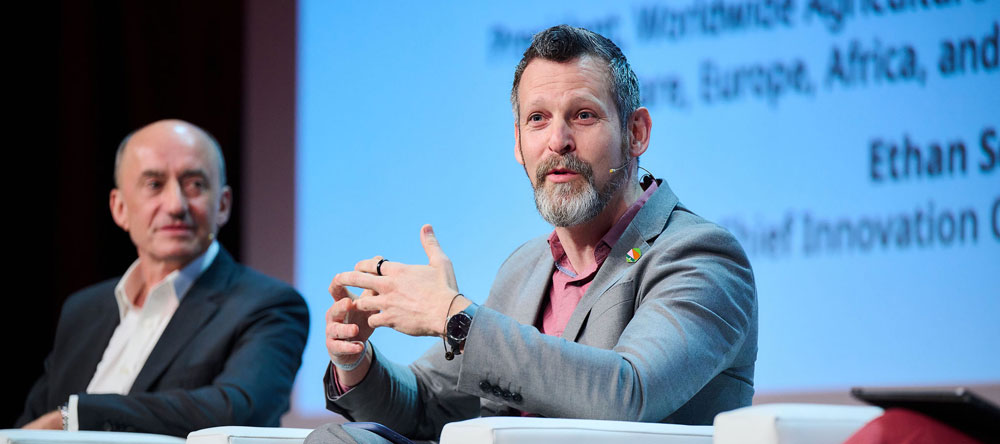
Data was also the topic for Ethan Soloviev, Chief Innovation Officer at HowGood. His organization is the world’s largest database for food and agriculture sustainability, tracking the carbon footprint, water footprint, biodiversity impact, labour risk and animal welfare credentials of 33,000 ingredients and around 4.5 million products globally, for clients ranging from Danone and Nestlé to major retailers.
Farmers should be able to own their data and be compensated for it, he said – “data can be a new crop”. With data, agriculture is uniquely positioned among economic sectors to move from being a source of emissions to a net carbon sink, through regenerative approaches that simultaneously enhance biodiversity and improve farmer livelihoods.
He also pushed back on the framing of Jurgen Tack’s living graph from the previous panel, which presented urban, agricultural and nature as competing land uses. His view was that they are nested systems: “agriculture is within the economy, which is within the social system, which is within nature.” AI, he suggested, offers the tools to optimise holistically across all of them simultaneously, rather than forcing trade-offs.
Agricultural intelligence
An optimistic perspective came from Martin Clough, Head of Digital, Collaboration and Sustainability in Crop Protection Research at Syngenta. He saw this as an “epic time” to be in research and development, driven by the convergence of generative AI, big data capability and breakthroughs in ‘omics’ science – the understanding of how chemistry and biology interact.
His concrete example was multi-parameter optimization: using generative AI to design new crop protection products by addressing multiple challenges simultaneously – efficacy, operator safety, consumer safety, environmental safety, sustainability – rather than solving them sequentially and making trade-offs. He likened it to a Rubik’s Cube: solving one side at a time inevitably scrambles the others, whereas AI allows all sides to be solved at once. He saw potential to cut years off the time-to-market for new products, delivering more and better solutions to farmers faster.
Safeguards were vital: Syngenta has put in place a trusted data mesh governing all R&D data, and a digital growth academy to build data literacy among scientists. “I have to demonstrate that the AI we’re using is trustworthy, or our scientists will not use it,” he said. “That means it needs to be explainable and understandable.”

From horsepower to smart power
Justin Rose, President of Worldwide Agriculture and Turf, Small Agriculture and Turf Care, Europe, Africa and Asia, at Deere & Company, joining online from the company’s headquarters in Illinois, said AI is already reshaping what happens in the field every day – a shift “from horsepower to smart power”.
Why is this important? He gave a striking illustration: in Europe, 23 trillion individual weed plants must be controlled every year to protect small grain cereal and oilseed crops. Research shows that weeds cover only 1-5% of arable land – but today, farmers broadcast-spray entire fields with herbicides. Deere’s AI-enabled sprayer can identify individual weeds and apply herbicide only where needed, at the rate of 10,000 weed identifications per second across a 36-metre boom moving at 20 kilometres per hour. “This can’t be done without AI,” he said. “AI allows machines not just to move, but to see and decide and act in real time under real farming conditions.”
Other advantages: autonomous systems – tractors that can operate day or night, supervised remotely – help with labour shortages and an ageing workforce; AI can help to make farming a high-tech, data-driven profession with new career paths. His message on regulation echoed others on the panel: “We need to regulate the outcomes and risks, not the innovation itself.”
The discussion: accountability, data and the social media lesson
Stephen Sackur drove the discussion with a pointed challenge: are we at a naively optimistic stage in our relationship with AI, one that mirrors the early days of the internet and social media? He said that the platforms that seemed to democratise information flow turned out to empower vast corporations scraping user data for profit. The question for agriculture is who controls the technology, who benefits, and how much autonomy stays with farmers.
Jessica Agnew urged the sector not to sit back, saying “we have the opportunity to engage now and help design those governance frameworks.” Martin Clough returned to Syngenta’s safeguards – it was vital to prepare in advance and be careful about how you are using AI.
Ethan Soloviev made a case for working simultaneously from the bottom up and the top down: open-source models and transparent datasets alongside outcome-focused regulation that identifies likely harms without stifling innovation. Europe could fall behind “if we slow down innovation with AI here”.
Stephen closed by noting that whether skeptical or optimistic, the panel had made one thing clear: AI is coming to food and agriculture regardless. The real question is whether it can be shaped to deliver the public and planetary good, rather than simply the interests of those who control the technology. The panel’s answer, broadly, was yes – but only if the sector engages now, builds the right governance structures, and ensures that the farmer, not just the platform, captures a fair share of the value created.