
2026 Annual Conference – Opening session summary
Tuesday, Apr 14, 2026
The 2026 Forum for the Future of Agriculture (ForumforAg) Annual Conference was held on Tuesday, April 14, 2026, in Brussels and online. The event consisted of live broadcasts, moderated panel discussions and dialogues, interactive interventions, networking opportunities and exhibitions.
Introduction and welcome

“We are living in the most uncertain and the most dangerous of times.” That was the message from Moderator Stephen Sackur, International Broadcast Journalist, who with Rose O’Donovan, Journalist & Editor AgraFacts, set the tone for the 2026 conference. The event came against a backdrop of acute global uncertainty – a timely moment for the theme of rebooting the food system. Questions of food security and food sovereignty had never felt more urgent – “it feels like the end of the world as we know it”, said Rose, referring to the title of the first panel session.
Before starting the official proceedings, the audience observed a minute’s silence to mark the tenth anniversary of the Brussels terrorist attacks of 22 March 2016, an event that had cast a long shadow over a previous gathering of the Forum in the same location on the day of the bombings.
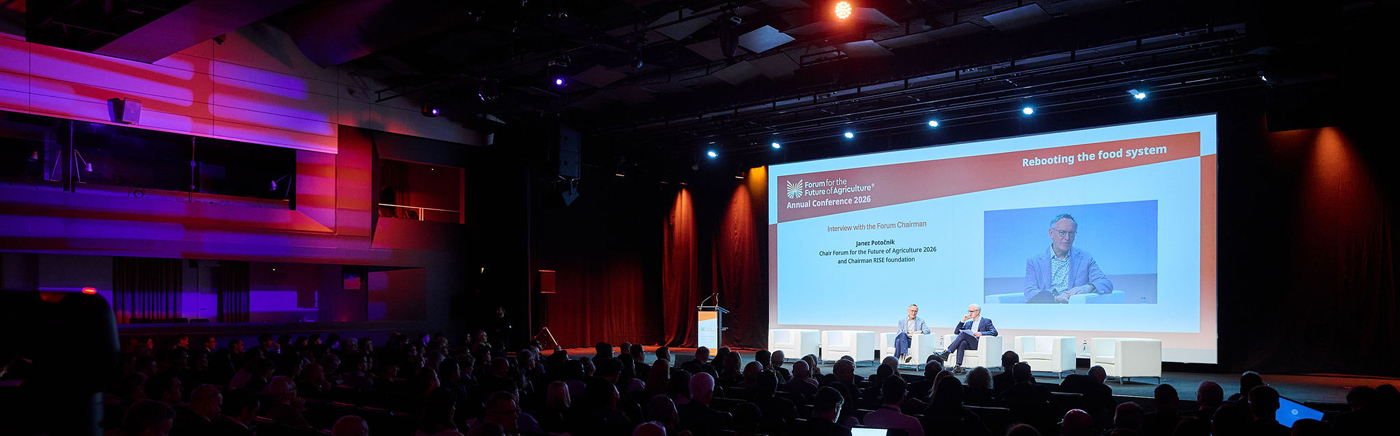
Interview with Janez Potočnik, Chair ForumforAg and Chairman RISE Foundation

Interviewed by Stephen Sackur, Janez Potočnik, Chair ForumforAg and Chairman RISE Foundation, said bluntly that the geopolitical situation was hard to read and changing by the hour. And it brought nothing good, least of all for agriculture. Chain reactions set off by conflict and instability have exposed just how fragile the interconnected systems underpinning food supply are. “If things move slightly, we all feel the consequences,” he said.
His main lesson was this: build a food system that is as resilient as possible through regenerative, environmentally friendly agriculture. “Everything else is riskier.” He drew a direct parallel with the extreme weather events that struck Slovenia in the summer of 2023, when flooding caused damage estimated at 16% of Slovenian GDP. The costs of inaction fall on individuals, on governments, and ultimately on European budgets, he warned.
Not everything can be resolved with strategic thinking and governments must help people through acute crises. But that is not an excuse to revert to business as usual the moment a crisis passes.
A consistent green agenda
Turning to the green and sustainability agenda, Mr Potočnik agreed that it is slipping down the political agenda in favour of energy policy and food security. “That’s a mistake, a strategic mistake that will be very costly,” he said. And he does not intend to abandon his efforts.
At Stephen’s suggestion that he was “a dreamer”, Mr Potočnik replied: “If there were no dreamers, this world would have already collapsed.” The lesson he drew from decades in policy was to stay consistent, keep repeating the message, and be patient. Circular economy, which he has long championed, is now a global trend. The fifth freedom – free movement of knowledge, research and innovation – which he proposed in 2007, is back on the agenda in 2026. “Sometimes in politics you have to be patient.”
Europe’s two main problems
On Europe’s structural challenges Mr Potočnik highlighted two fundamental problems. The continent lacks energy resources, material resources, and competitive economic platforms, countries fail to work together. Tax competition between member states is a self-defeating example of collective weakness. Europe’s real opportunity lies in demonstrating that a democratic, advanced economy can function under resource constraints. “We have to understand that, if we work together, we can actually lead and not just follow.”
Does Europe need to be more aggressively protectionist in the style of President Trump, asked Stephen. Mr Potočnik was sceptical. Europe has always championed openness and cooperation, and that instinct should not be abandoned. His reasoning went deeper than economics: we are the first generation living in a world of genuinely planetary scope – more interconnected and interdependent than any before, whether through climate change, pandemics, the internet, AI or trade.
Change is coming whether humanity chooses it or not, he said. History shows that when reason does not prevail, change is forced by disaster. The evidence is already visible: seven of nine planetary boundaries have been crossed, future generations are being indebted, and natural resources are being depleted. Mr Potočnik concluded: “We are apparently the most intelligent species on Earth and it’s high time to prove it.”