
2025: Innovation, AI & Digitalisation event
Wednesday, Jul 09, 2025
Forum event looks at the future for agriculture
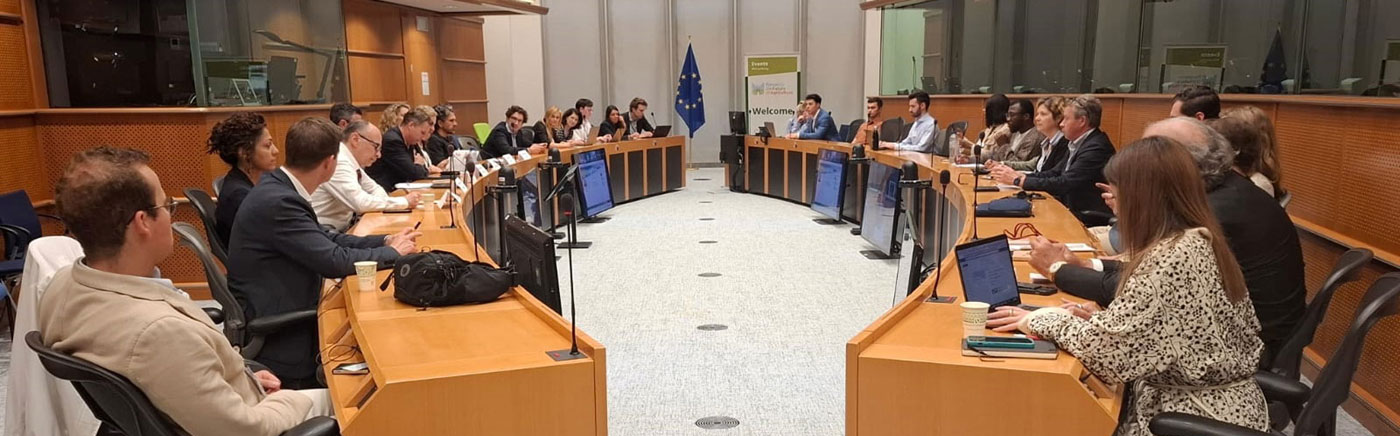
Digitalisation in agriculture is advancing rapidly, raising questions about its benefits and challenges. A special Forum for the Future of Agriculture event, co-hosted by MEP Maria Grapini, took place on Thursday June 26 at the European Parliament in Brussels. It aimed to share expertise on digital agriculture’s promise, practicalities, and policy implications. This event served as a follow-up to a discussion held in January 2024.
Mark Titterington, Co-founder and Director of the Forum for the Future of Agriculture and Moderator, welcomed attendees and highlighted the Forum’s focus on the future of agriculture. “I don’t think that there is a topic more futuristic and future-looking than AI and digitalisation and what that means for agriculture,” he said.
Mark acknowledged Microsoft as the Forum’s first tech partner and co-organizer of the event.
He shared a personal experience of using an AI tool to gain insights about farmers’ perspectives on AI and digitalisation. Farmers saw both opportunities (task automation, precision input use, water optimization, data-driven decisions, enabling ecosystem service markets, labor shortage management) and concerns (skill gaps, rural connectivity, adoption costs, data privacy).
Perspectives from Maria Grapini
Mark then handed over to Maria Grapini, Member of the European Parliament from Romania, who also serves as Vice President of the Internal Market and Consumer Protection Committee (IMCO) and a member of the Agriculture Committee.
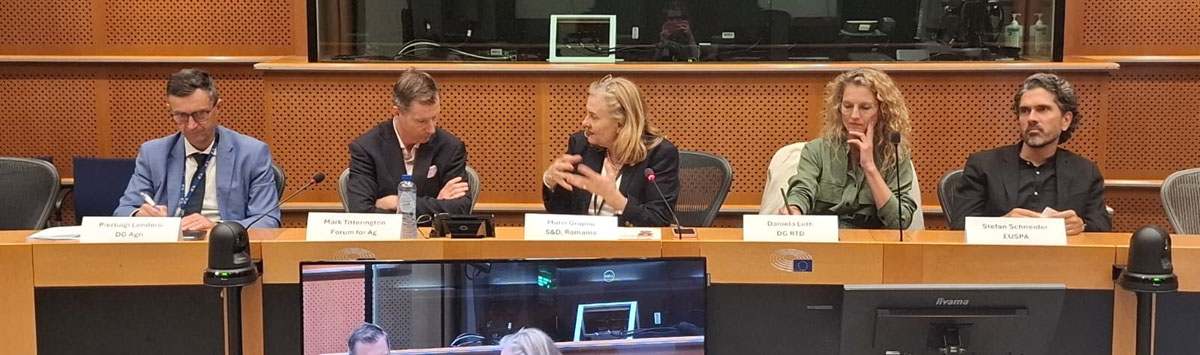
Digitalisation in agriculture is vitally important, particularly for addressing rural depopulation and fostering related industries, said Ms Grapini. She was pleased at the ongoing debates within the European Parliament to integrate innovation and digitalisation into the Common Agricultural Policy (CAP).
Romania is making progress: the country still faces challenges but there are positive developments, including a supportive Minister for Agriculture, a club for young farmers, a program to invest in digitalisation and innovation, and an institute for research.
Insights from the World Bank
Kateryna Schroeder, Senior Agriculture Economist, Global Engagement unit of the Agriculture and Food Global Department, The World Bank, joined online – on the day the Bank soft-launched its report Harnessing Artificial Intelligence for Agricultural Transformation – and gave a comprehensive view of the current state of AI across the agricultural value chain.
AI is drastically amplifying the promise of digital agriculture by identifying patterns in massive, diverse datasets and simulating complex scenarios related to weather, soil, pests, and diseases, she said. There is significant growth in AI for agriculture, projected to rise from $1.5 billion in 2023 to over $10 billion by 2032.
The current applications of AI include research and development (faster discovery times), input supply (improved targeting and efficiency), production (higher productivity, higher yields, and farm efficiency), post-harvest (reduced losses, improved quality), and distribution and logistics (increased efficiency).
The World Bank report highlights 60 promising and scalable AI applications, which will also be available on an accompanying dashboard. Ms Schroeder shared numerous examples:
- AI-powered extension services providing tailored advice to farmers: “probably the most promising use case, particularly in developing countries” (e.g. Digital Green AI-powered chatbot, and “virtual agronomists” ).
- Markets, distribution, and logistics: Transforming supply chains (e.g. the Climate Lens platform provides small-scale climate forecasts, reducing climate-related losses by up to 25%. A “marriage between blockchain and AI” is creating next-generation traceability systems.
- Inclusive finance and risk mitigation: AI-powered credit scoring and index insurance.
Digital divide and other challenges
The digital divide is a major challenge. North America, EU, and Australia are well-prepared, but many other countries are lagging behind. Critical issues include connectivity and energy infrastructure; quality of data – “AI systems are only as good as the data that you put into them”; digital literacy and trust in devices; and lack of specialized data scientists.
Positive trends include satellite internet, on-device AI models, and growth in renewable energy, as well as growing farmer confidence in using smartphones.
Five key enablers for AI in agri-food systems
Ms Schroeder highlighted five key prerequisites : networks, energy, data governance, human capital, and public-private partnerships. “These form an interconnected ecosystem where investment in one area supports others, offering a strategic opportunity for developing countries to leapfrog traditional developmental paths.”
While evidence is still emerging, the AI uses with the greatest potential impact are research and development, and providing complex information in digestible form for famers. Inclusive participation, she said, called for “foundational digital public infrastructure” – something which governments are increasingly recognizing.
Panel 1 – Agtech at the crossroads: Promise vs. practicality
Mark Titterington welcomed Daniela Lüth, Policy Officer, DG Research & Innovation, B2 – Bioeconomy & Food Systems, European Commission; Alin Luculeasa, Farmer member, Romanian AGRINNOVATOR ThinkTank; Jørgen Audenaert, Manager, Small Grains Production System Innovation & Dairy and Livestock, John Deere; and Stefan Schneider, Space Downstream Entrepreneurship Officer, EUSPA (EU Agency for the Space Programme).
He invited them to state what excites them most about AI and digitalisation in transforming the agri-food system.

Stefan Schneider of EUSPA highlighted the organization’s commitment to the future of agriculture through technologies like Galileo and Copernicus, aiming to make agriculture smarter and more environmentally friendly. “We can already see the impact that satellite technology is playing at the moment for European farmers,” he said.
Romanian farmer and agri-innovator Alin Luculeasa joined online. As an example of what can be achieved, he shared a personal experience – winning a best digitalisation project in agriculture award for sustainable cereal production using conservation agriculture and digital innovation on his farm, in a region considered marginal for industrial farming. “Agriculture is clearly unpredictable… yet, with the rise of new technologies, digitalisation and AI, agriculture can become far more secure,” he said. Two dimensions stand out: Adaptive biotechnologies that develop plant and animal varieties’ resistance and adaptability, and the ability to algorithmically drive every aspect of farm operations. He also called for open data infrastructure, financial support, and clear regulations.
Jørgen Audenaert of John Deere, also online, followed: “What excites us is the key opportunity to both deliver more value to our customers, the farmers and the contractors, and at the same time enable more sustainable farming practices.” Customers face four key challenges: maintaining profitability in volatile markets, producing more food with fewer inputs, adopting and contributing to climate change, and addressing labor shortages. He heralded “a step change in how we plant, fertilize, protect our crops and harvest” thanks to innovations like high-precision guidance and connecting machines to digital platforms. A clear, reliable, and consistent long-term vision for agriculture is vital to give customers certainty and confidence to invest in technology, he said.
Daniela Lüth of DG Research and Innovation highlighted the role of Horizon Europe, the world’s largest publicly funded research programme, particularly Cluster 6 (agriculture, forestry, environment, bioeconomy, food). Digitalisation and AI are a means to an end, she said, but there is a need for capacity building and application, and a systemic approach: “What’s exciting is the immense speed we see, exponential growth, as well as the democratization of innovation.” Horizon Europe projects are developing user-friendly, lower-cost applications accessible to small players and SMEs, fostering creative approaches. Digitalisation can smartly combine competitiveness and sustainability, making them two sides of the same coin.
Mark then asked follow-up questions of individual panellists on specific points.
How do we move research from pilot applications to scale in a collaborative way?
Daniela Lüth: Horizon Europe’s work program (Cluster 6) for 2025 has a strong focus on innovation actions, with one-third of projects requiring a high Technology Readiness Level (TRL 5-8). The European Innovation Council (EIC) is providing €10 billion for activities from lower TRLs (TRL 1-4,) to market-ready solutions. Additionally, a new EU Startup and Scaleup Strategy aims to address the gap between excellent research and market scaling, focusing on capacity building and capital investment.
How are digital tools and technologies changing day-to-day operations?
Alin Luculeasa: Data from digital tools allows tailored decisions for each field, which had led to a 50% reduction in fertilizer use across the entire farm without yield loss. Real-time satellite imagery provides detailed stress maps, highlighting water deficit, disease, and nutrient shortages, enabling precise, spot-specific treatments instead of widespread chemical application. However, the biggest challenge is his team’s reluctance to embrace new systems, due to fears of losing control, requiring him to carry out constant monitoring and intervention.
What do customers say about how technology transforms daily operations, and are there are regional differences?
Jørgen Audenaert: The key for customers is to understand and see the value of new solutions on their farms, and for easy-to-implement due to tight time windows. This often involves training, which John Deere invests in, along with developing specialists within their distribution channels. They also measure technology utilization and outcomes to identify where further support or user experience improvements are needed. While specific adopted technologies may vary regionally, the underlying customer behavior for adoption is similar worldwide.
What are the current limitations of satellite technology in agriculture and how are they being overcome?
Stefan Schneider: Adoption is progressing well, there is engagement in the industry. Limitations include frequency of observation (every 4-5 days): bad weather limiting visibility; processing time for large volumes of data.
Despite these, the industry is creative, as in EUSPA’s new High Accuracy Service, narrowing navigation signals to a decimetre level for greater precision. One significant challenge is interoperability between different systems from various companies, which farmers frequently report as an issue and EUSPA cannot directly solve.
A consensus on the future: revolution ahead
After questions from the audience, Mark asked the panellists: By 2035, will AI and digitalisation have revolutionized agriculture, or will we see normal technological innovation? The consensus was revolution or disruption if that term if preferred. As Daniela Lüth said: “it’s going to come fast”.
Panel 2 – Navigating governance: Policy challenges in agri-digitalisation
Mark welcomed Tassos Haniotis, Special Advisor for Sustainable Productivity, Forum for the Future of Agriculture; Senior Guest Research Scholar, IIASA; Pierluigi Londero, Head of Data Governance, DG AGRI, European Commission; and Ornella Cosomati, Director Europe Energy and Sustainability Policy, Microsoft.

Mark Titterinton opened as in panel 1, by asking panellists what excites them? The discussion that followed was around what is needed to fully unlock these aspects.
Pierluigi Londero of DG Agri highlighted three key areas: productivity, simplification and complex agricultural practices.
Ornella Cosomati, from Microsoft, emphasized AI’s role in decarbonizing industries, including farming, by maximizing efficiency. “Farmers… are clearly facing economic pressures, environmental challenges, they need to produce more to feed an ever-growing population, but with less resources. Technology has this incredible opportunity to maximize efficiency across different industries.” She shared examples, including of enabling measurement, improving efficiency, and supporting carbon farming. Ms Cosomati introduced Azure Data Manager for Agriculture (ADMA), a Microsoft tool designed to empower farmers with data-driven insights, and Microsoft’s AI chatbot (Co-pilot) to answer simple questions and inform decisions. She also highlighted Terrain AI, a modelling platform developed with an Irish research centre, which allows governments to test policies before implementation.
Why is Microsoft interested in agriculture? Mark was interested to know, with Ms Cosomati explaining the company sees significant potential for efficiency gains in agriculture and for decarbonization.
Tassos Haniotis said that “AI is here to stay and grow, there is no way of stopping it,” but like any technology, it brings both opportunities and challenges, as well as benefits and costs that aren’t always directly linked. In agriculture, AI has applications where the benefits outweigh by far whatever costs we see – “although we don’t necessarily believe it.”
He made three key points: Data quantity is growing exponentially, but quality control is decreasing. Use of data means AI has significant potential for improving land management, leading to measurable outcomes for sustainability. AI can help bridge the gap between economic and environmental aspects in policy. And abuse of data “scares people” – there is a critical need for a flexible public policy framework that avoids past mistakes, ensures interoperability, and provides incentives.
Mark then opened a round of questions to the participants.
What are the key features of a policy framework to enable the right use of AI and data, reaching as many farmers as possible, and ensuring data quality?
Pierluigi Londero of DG AGRI referenced the EU’s comprehensive data strategy and avalanche of legislation making the EU the first bloc with such rules. He stressed the need for a clear legal framework for certainty. Legislation can also be a brake, but also “push the accelerator” .
Europe aimed to be “the AI continent”, focusing on infrastructure, a sectoral AI strategy, and boosting data availability to feed AI. With this, “we should be able to advance and make big steps in Europe… we can tailor more targeted support than initially.”
What does Microsoft need from public policymakers as enablers and collaborators?
Ms Cosomati mentioned internet access to close the digital divide; stronger financial incentives; upskilling for farmers; and better infrastructure, e.g. investing in cheaper electricity. She hoped that digital technologies and policy frameworks would attract more young farmers and women into farming.
How do we ensure continued funding at EU and member state level for rural development, connectivity, and infrastructure?
Tassos Haniotis argued that the focus should be on asking the right questions “which I don’t believe we are doing right now”. He believes leveraging the enormous wealth of information generated by AI tools can inform pertinent policies and determine necessary funding. Mr Haniotis warned against current policy directions that risk leaving up to 50% of agricultural land without the current level of support, and expressed frustration over the lack of impact assessments and analysis in policy-making.
At EU level, how do we ensure asking the right questions to the right people, in a way that they can answer them?
Tassos Haniotis: All three EU institutions (Commission, Parliament, Council) must learn from past mistakes in co-decision. The communication strategy must start with the proposal, not end with it, to explain solid analysis behind proposals and counter amendments. Parliament needs an independent research service to provide unbiased assessments of proposed legislation. And Member States do not trust each other as they once trusted the Commission. The Commission’s legislative initiative remains its “big gun” – making proposals based on solid analysis and focused on main areas increases success and avoids add-on legislation later.
Daniela Lüth joined the conversation and agreed on the importance of coherence, noting increasing efforts across different DGs to coordinate initiatives and strategies which show positive cooperation.
Changing the focus slightly, Mark asked: How is Microsoft, in particular, applying AI and digital solutions to improve water efficiency forecasting and usage at the farm level?
Ornella Cosomati said Microsoft is committed to being water-positive by 2030 and is looking at applying digital technologies to municipal water systems and farm-level projects. She mentioned a project in Spain with Agroanalytics, a precision irrigation startup, using data to generate informed irrigation recommendations for 200 hectares, and Microsoft’s FarmVibes open-source tools.
Mark repeated his earlier question: By 2035 will AI and digitalisation be revolution or incremental technological innovation? The answers indicated a strong consensus for revolution, albeit with a recognition of challenges like the digital divide.
In closing, Mark highlighted two key aspects of agriculture’s future that he finds exciting: Increased collaboration and new investment flowing into the sector, and the rapid pace of change.
You can find out more about the agenda and speakers and watch videos from the event by clicking here.