

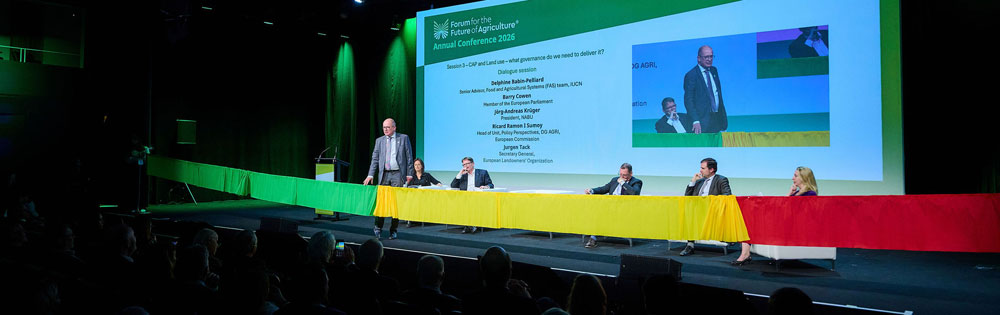
2026 Annual Conference – Session 3: CAP and Land use – what governance do we need to deliver it?
Tuesday, Apr 14, 2026
The reform of the Common Agricultural Policy (CAP) – and the governance structures needed to deliver it – was the focus of the third panel. Five panellists offered sharply different but often complementary perspectives on what needs to change, and how fast.
A new direction of travel from the Commission
One of the key architects of the overhaul of the future CAP set out the direction of travel. “Simplification, less administrative burden for farming and for operators” were the goal, said Ricard Ramon I Sumoy, Head of Unit, Policy Perspectives at DG AGRI.
He described a shift away from top-down regulatory mechanisms from Brussels towards more bottom-up, market-based solutions with greater cooperation across the food chain. Flexibility is central: policies need to be able to adapt to a rapidly changing reality. Two-thirds of the actions promised in that vision, he said, are now being implemented.
The future CAP sees a rebalancing of powers between the EU and member states: some areas will gain more national flexibility; others will retain clear direction from Brussels. “Very importantly, the farmer should get more autonomy,” he said. The new green architecture replaces mandatory conditionality set at EU level with a system in which member states define basic parameters. Mr Ramon highlighted two flagship initiatives illustrating the new approach. The On-Farm Sustainability Compass to help the farmer navigate multiple sustainability standards, and the Farmland Observatory, responding to growing pressure on land access.
“We think that with all these different aspects… we will be better placed to empower our farming communities to better address the big challenges ahead.”
“Ambition without funding will fail”
The ambition in the Commission’s proposals is real, but the budget proposed to deliver it is not: there is a 20% gap. That was the blunt assessment from Barry Cowen, Member of the European Parliament and Renew, Ireland. “How it can be delivered is dependent solely and totally on finance and on budget,” he said. “It’s as simple as that, and it’s as plain as that.”
He said funding had to deliver generational renewal, a rewards-based system, and simplification – and not forgetting the vast number of smallholdings. He understood the need for defence and security spending but “you can’t have a commitment on defence and safety without a pro rata commitment on food security”. He suggested that frontloading Mercosur safeguard funding and redirecting rural development spend, currently outside the CAP envelope, could bridge the immediate gap.
“Innovation is the only answer”
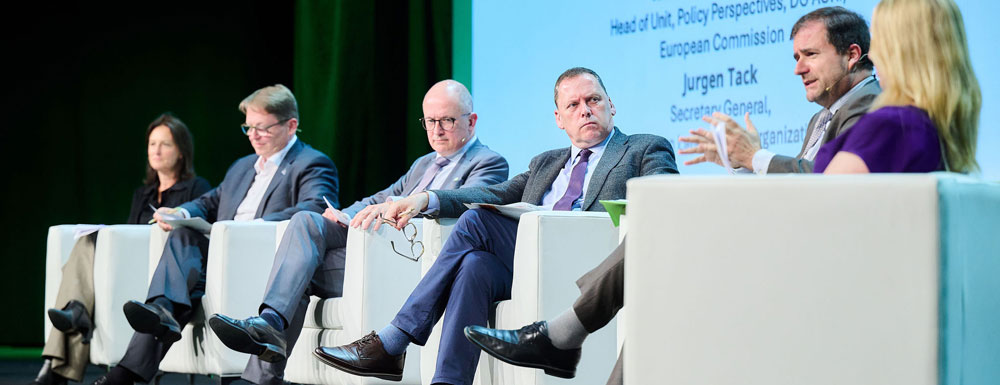
Jurgen Tack, Secretary General of the European Landowners’ Organization, brought an unconventional visual aid: a ‘living graph’ banner showing the changing division of land between nature, agriculture and urban areas over time. Agricultural land has decreased through producing more on less land, he said. The growing pressure on agriculture comes from urban expansion, yet the environmental and farming communities talk to each other rather than to the encroaching cities.
But producing more on less called for innovation – something which is now stifled. “The only way we can cope with climate change, a growing population and environmental problems is innovation,” he said. Europe develops biocontrols, precision farming tools and feed additives – but consistently fails to bring them to market. A company with a market-ready biocontrol faces three options: go bankrupt waiting for regulatory approval; sell to a larger company with the resources to wait a decade; or move to the US or Brazil, where approval takes two to three years. Europe then blocks imports of the crops grown using the very products it helped develop.
Innovation sent Artemis II around the moon – and he called on policymakers to take their lead from that.
More of the same will not be enough
The ability of the new CAP to future-proof agriculture was also questioned by Jörg-Andreas Krüger, President of NABU. The CAP to date has not addressed agriculture as a primary driver of biodiversity loss in Europe and a significant source of greenhouse gas emissions. Nor has it dealt with deep structural distortions – unequal land access, global competition, labour cost differences or the steady loss of farm holdings. “We were surprised that the proposal is more of the same… not setting priorities on the protection of the environment and of the ecosystem services for the future.”
Among the changes he wanted to see: an ambitious ring-fencing target for environmental and climate measures within the CAP, revised co-financing arrangements to shift the balance from direct payments to agri-environmental measures, and payments tied to performance rather than the status quo.
He highlighted “a few good ideas”, such as a robust EU-wide farm stewardship approach that genuinely rewards sustainable land use. “We have to come to a solution where ecologically better farming is economically better farming as well,” he concluded.
Competitiveness and nature are not in conflict
Delphine Babin-Pelliard, Senior Advisor for Food and Agricultural Systems at the IUCN, framed her contribution around “a false choice”. The debate is not environment versus competitiveness and food security – the question is how to secure Europe’s production systems for the next 10, 20 or 30 years. The answer is by investing in nature, she said.
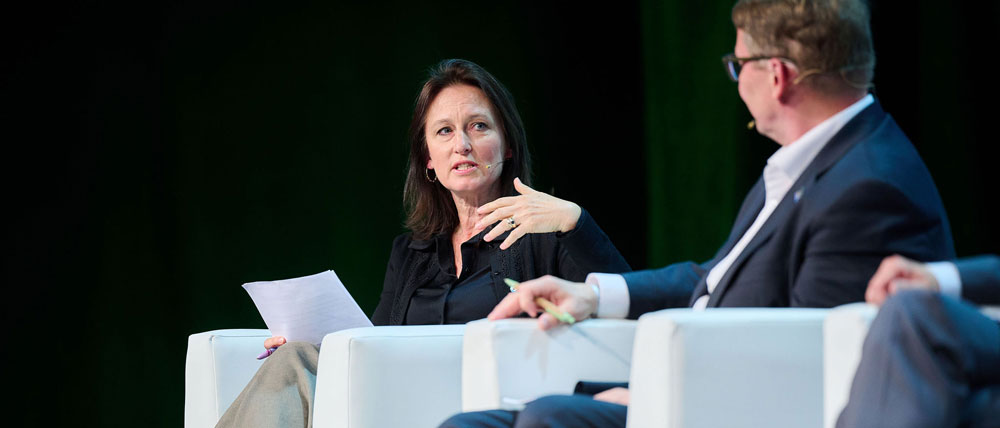
The IUCN Congress in 2025 was clear: the transition towards nature-positive agriculture must accelerate. This produces three governance priorities: first, aligning EU policies and improving coordination and accountability; second, building inclusive platforms; third, governance must guarantee non-regression.
On eco-schemes, Ms Babin-Pelliard said early evaluations show many are not ambitious or targeted enough to drive real transformation. The question, she said, is what they need to become – refocused on soil fertility, water regulation, carbon storage and pollination. “Competitiveness increases when nature is part of the system…and protecting nature is a long-term investment in food security and the economy,” she ended.
The discussion: governance in practice
Among the issues discussed was the proliferation of Commission initiatives: how would they be coordinated and work on the ground, asked Rose O’Donovan. Ricard Ramon was clear that these are not new regulations but bottom-up initiatives responding to identified gaps, for example, the Farmland Observatory was requested by young farmers and backed by a European Parliament resolution.
Rose turned to the new governance structure: does it risk fragmenting the ‘common’ in the CAP? Barry Cowen said that he was broadly open to new structures and architecture, if they can deliver and if they are adequately funded, although there were discussions still to be had.
Coming back to regulatory speed, Jurgen Tack expanded on his biocontrols example, arguing that omnibus simplification packages are moving in the right direction but not fast enough. Jörg-Andreas Krüger cautioned that public acceptance of environmental legislation remains strong – evidenced by NABU’s continued membership growth even in times of economic hardship. The challenge is to make processes faster and simpler while keeping them safe; there is, he felt, more common ground between the different sides than the public debate implies.
The last word went to Mr Tack: keeping agriculture stable, he said, is like keeping a patient stable. It requires a doctor capable of making urgent decisions.