
Food Systems Podcast 94
Interview with Jessica Agnew
Monday, Apr 13, 2026
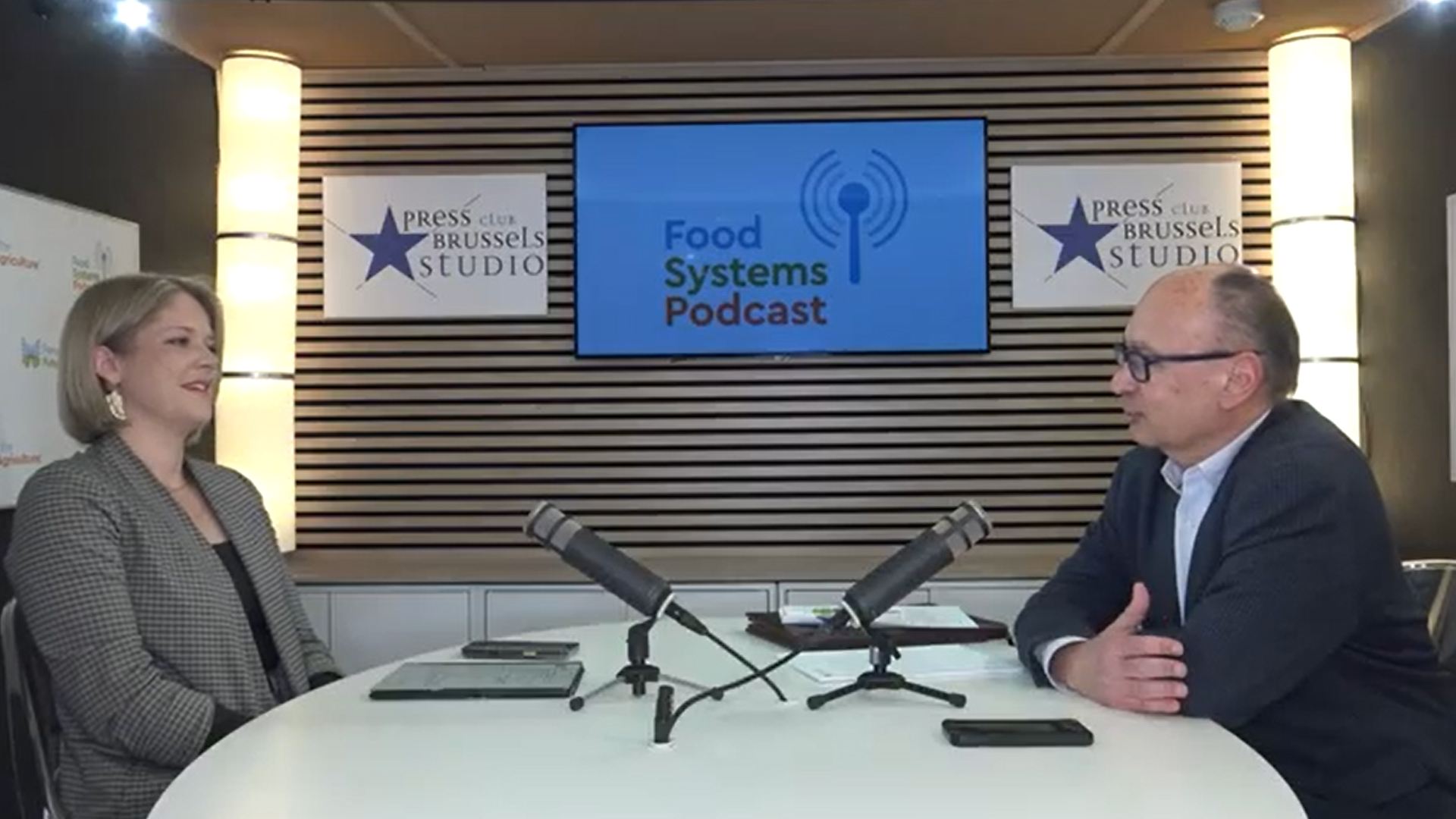
In this edition of the Food Systems Podcast, recorded at the annual conference, Tassos Haniotis, Special Advisor for Sustainable Productivity, Forum for the Future of Agriculture, talks to Jessica Agnew, Director of the GAP Initiative and Managing Editor of the Global Agricultural Productivity (GAP) Report, Virginia Tech. They discuss global trends in agricultural productivity growth, the importance of productivity growth to meet increasing demands, and how policy decisions significantly impact productivity outcomes.
Here is a summary of the conversation.
Jessica, tell us what you do, and what brings you to the Forum’s annual conference?
I’m Managing Editor of the GAP Report, which is at the heart of the initiative. The project was started in 2010 by a group of agribusinesses to find out how sustainable productivity growth could meet competing demands for agricultural products. The report gained a global following and influenced policy, investment, and operational decisions. It moved to Virginia Tech in 2019: we analyse objectively through a storytelling lens, making it accessible to different audiences and helping build bridges across different ideologies in the agri-food system.
Productivity tells us how much more we’re getting out of our inputs. And that reflects improvements in fertilisers, genetics, and precision agriculture. When productivity growth slows, that tells us something important about the state of innovation. That’s what drew me to the GAP Initiative, where I’ve now been working for three years.
What are the key findings of the GAP report, and where can people find it?
The report comes out every year in October. We report on an internationally comparable dataset on agricultural productivity that allows comparisons between countries.
In the past several years Total Factor Productivity (TFP) – which measures productivity across land, labour, capital, and materials – is slowing. We want productivity to be growing: it is effectively land-sparing, helps preserve biodiversity, and reduces the environmental footprint of agriculture. In the early 2000s, we were averaging around 2% TFP growth per year. That has been cooling for the last decade or so, and the average we reported last year is just 0.7%. To sustainably meet demands on our agricultural system – not just food, but fibre, fuels, and feed – we need to be averaging 2% annually. We have to make up that gap.
What are the main factors driving this slowdown in productivity growth?
There are two main drivers. The first is adoption – there are technologies, tools, and management practices that already exist, some for decades, that farmers still aren’t using, whether because of financing, or because extension systems aren’t reaching them. Policy can also be a barrier: subsidies in some regions distort the use of certain inputs.
The second driver is investment in agricultural R&D – we need enough of it to keep pushing the frontier of what’s possible. That’s becoming increasingly complicated in an era of changing climates, extreme weather events, and geopolitical and economic shocks. In summary, in some areas we’ve reached near-saturation with earlier productivity-enhancing tools like improved genetics, and we’re seeing a real slowdown in regions that historically led productivity growth, which is pulling the global average down.
What do regional differences tell us?
South Asia – India in particular – and Northeast Asia, including China, are the current productivity frontier leaders. They’ve been driving major investments in agricultural R&D, both public and private, and prioritising the adoption of information and communication technology, especially among smallholder farmers. South Asia is currently averaging 1.48% total factor productivity growth annually; Northeast Asia is at around 1.9%.
North America, by contrast, has essentially zeroed out its productivity growth in the past decade. Sub-Saharan Africa continues to struggle, averaging around 0.3% annually. That region really exemplifies the need to ensure farmers can access the right tools – and these don’t have to be the most advanced precision agriculture technologies. Even basics like improved genetics and seed varieties can make a significant difference.
In Africa and Latin America, is productivity growth being driven by R&D and technology, or by bringing new land into production?
In Latin America, there hasn’t been much land extensification – moving into entirely new lands – but there has been conversion of pasture to cropland. Most of their output growth is still coming from input intensification. In Africa, output growth is mostly being driven by land extensification. From an environmental perspective, this is not the story we want to see: converting land rich in biodiversity into agricultural production can lead to serious environmental degradation. We would much rather see Africa increasing what it can grow on the land already in production.
What does the path forward look like? How do we close the gap between 2% annual productivity growth and the current 0.7%?
The GAP report looks at different technological domains that emerge as agriculture develops – from land extensification and mechanisation, through input intensification, into efficiency optimisation through precision agriculture and advanced genomics, and now into what we call systems integration. This newest domain recognises that agriculture sits within environmental, social, and economic systems, and the tools emerging now try to achieve productivity growth in light of those interactions.
Europe is actually a strong example – it has maintained relatively stable TFP growth of around 1% over several decades. Its focus on efficiency optimisation and systems integration tools has positioned it well as climates change and pest and disease pressures increase. The two main things we advocate for are, first, driving adoption of existing tools – even in the US, adoption of later-stage tools like variable rate technologies is still only around 30-40%. And second, continuing to push the frontier out across all technological domains.
North America and Europe have similar TFP growth rates, but with very different models. In Europe (including Russia and Ukraine), most of the growth is happening with an input extensification. In North America (Mexico, Canada and the US), it’s with input intensification. What does policy have to do with it?
The policy environment is fascinating. Mexico has averaged 2% total factor productivity growth annually in the last decade. Canada averaged 1.8% between 2011 and 2020 – but that has dropped to nearly zero. Between 2015 and 2020, Canada implemented a mandate to reduce agricultural emissions by 30%, driven by top-down requirement rather than allowing farmers to determine how to achieve it, and introduced before farmers had the tools to maintain productivity and profitability.
In the US, the decline goes back further. Public investment in agricultural R&D started falling in the 1980s, and there is a 20-30 year lag before that shows up in productivity data. Within the research funding that does exist, there has been more than a 100% increase in economics funding, but a significant decrease – more than 30–40% – in topics that would directly drive productivity growth. Canada has a very similar agricultural environment to the US, so that drop-off tells us a lot about the impact of policy.
In the EU, total factor productivity growth is holding at around 1%, but there is negative output growth – reflecting a very different ideology about Europe’s role in global agriculture compared to, say, the US view of itself as the world’s breadbasket.
These findings will need to be revisited in light of rising costs of production, higher food prices, and pressure on farming incomes. To summarise, the main takeaways are that there is no single global model. Research and development has played a significant role in driving total factor productivity growth, but the focus now must be on using inputs more efficiently. And we need to examine much more carefully which policies are helping and which are holding productivity back.
You can find more detail of the GAP report here: globalagriculturalproductivity.org

Jessica Agnew
Dr. Jessica Agnew is the Director of the Global Agricultural Productivity (GAP) Initiative and Associate Director of...see more

Tassos Haniotis
Tassos Haniotis recently retired, after a 33-year career in the Commission, as the Director of Strategy, Simplification and Policy...see more