

Putting resilient food systems at the heart of geopolitical stability
Roundtable summary
Wednesday, Sep 30, 2026
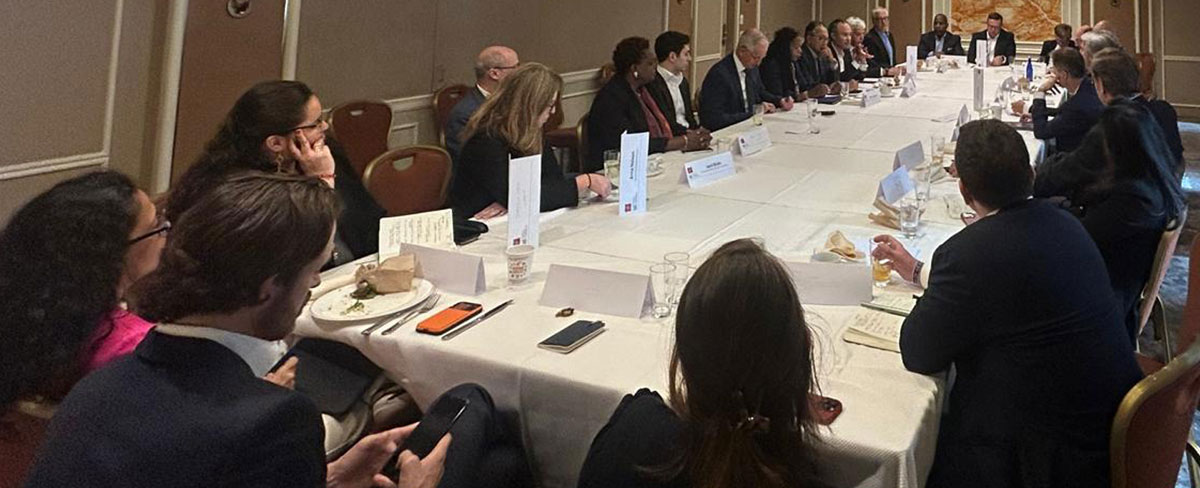
The Council on Foreign Relations and the Forum for the Future of Agriculture convened a roundtable discussion with more than 30 high-level stakeholders on the sidelines of the 81st United Nations General Assembly and New York Climate Week. The event explored how to build and put resilient food systems at the heart of geopolitical stability.
This is a task that grows more urgent with each turn of the current instability, conflict, and climate disruption impacting the geopolitical system. Attacks on Black Sea grain infrastructure and a fertilizer shock stemming from the war with Iran are striking global agriculture at both ends of the production cycle, while the El Niño forecast threatens rainfall across major growing regions. At the same time, food is increasingly wielded as an instrument of war; combined with fragile supply chains, export restrictions, and fertilizer dependencies, it now represents a serious threat to global security.
To stimulate the discussion, the roundtable was opened by Alvaro Lario, President of the International Fund for Agricultural Development. This was followed by statements from Máximo Torero Cullen, the Chief Economist, UN Food and Agriculture Organization in Rome; Ottilia Maunganidze, the Head of Special Projects at the Institute for Security Studies in Pretoria; and Ted McKinney, the former U.S. Under Secretary of Agriculture for Trade and Foreign Agricultural Affairs, now serving as the CEO of the National Association of State Departments of Agriculture.
Several key insights and recommendations emerged from the ensuing discussion, moderated by Michael Werz at the Council on Foreign Relations. These included:
The need for policymakers and key stakeholders to build response and early action systems that are less passive and that better anticipate and enable action in future crises, going beyond the deployment of emergency funding. Such new strategies require moving towards multi-dimensional approaches, including uncertainty foresight and analysis and gaming multiple risk scenarios.
Furthermore, it will be important to better understand and plan for future scenarios where, for example, a conflict between the United States, Israel, and Iran, leads to people searching for energy and food resulting in violent conflict at gas stations and grocery stores in South Asia, far removed from the military battlefield.
Participants suggested that in the future food system efficiency needs to account for greater resilience and not just factors such as productivity, distribution, and price, and affordability. To achieve these goals, the global community needs to shape public policies that drive food system resilience and address the hidden costs of failing to do so.
A fair, rules-based trading system was also identified as a critical factor in food system resilience and geopolitical stability. Several participants stated that local, regional and global trade relations were essential for effectively distributing food, to make it accessible in the right quantities to the right people at the right time. One of the key challenges in the current trading system is the fact that the effects of any geopolitical conflict are most acutely felt in the global South.
At the heart of the challenge lies the need to continue and intensify efforts to build a better, more resilient food system. Therefore, it is important to ensure, that all parts of the world can contribute, and enjoy the broader socio-economic and environmental benefits, of a productive and resilient food system.
This requires improvements in soil health, alongside conservation and replenishment of water, as critical building blocks that should be invested in. In addition, accessible, well-regulated technology, especially artificial intelligence constitutes a critical component that can inform better decision-making at the farm level and across the value chain.
To achieve these goals, participants argued that leveraging public, philanthropic, and private capital in targeted ways and working in unison is necessary to reinforce these efforts – this includes research and innovation to strengthen the backbone of the global food system.
In summarising the above points at the conclusion of the discussion, Mark Titterington, from the Forum for the Future of Agriculture, reflected on the need for systems-thinking to account for the dependencies, collective ownership and action, as well as the urgency and wide-ranging benefits, of building and putting food system resilience at the heart of geopolitical stability.