

2026: Market outlook workshop: From market uncertainty to farm resilience: priorities for the future of agriculture
Event summary
Tuesday, Oct 27, 2026
On October 13 and 14, 2026, the Forum for the Future of Agriculture, together with the Kujawsko-Pomorskie Region, brought together experts and stakeholders for the third edition of its workshop on market outlooks and policy implications. The workshop, held in Brussels, started with the latest OECD-FAO Agricultural Outlook and its 2026–2035 perspective, before zooming in on the forces shaping global markets and the future of European agriculture. Day 1 examined the uncertain outlook on world markets, three What If? scenarios for European agriculture, and the prospects and challenges for sustainable productivity growth.
Welcome
Elżbieta Piniewska, Chairwoman of the Kujawsko-Pomorskie Voivodeship Assembly, opened by offering “a humanist message”, highlighting the demands placed on farmers in Europe in terms of adapting to fluctuating costs of production, market demands, water conservation and the need to continuously develop the farming sector.

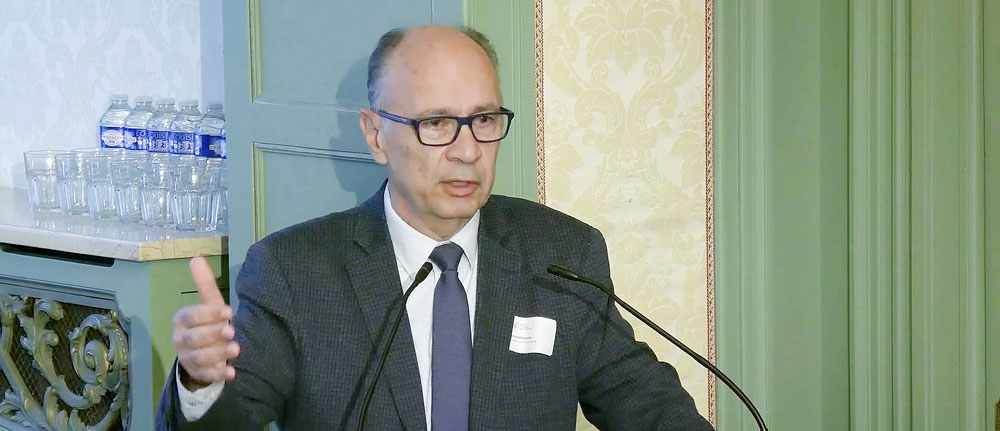
Moderator Tassos Haniotis, Special Advisor for Sustainable Productivity, ForumforAg and Senior Guest Research Scholar at IIASA, set the context by saying “uncertainty is what is coming out” of the data. He stressed he could not recall a time of such uncertainty in market projections. He argued “we need more than ever an outlook exercise and a baseline” because “without the discipline of trying to understand what has caused things in the past and what is the likely outcome in the future – based on different scenarios – we’re going to go nowhere.”
He argued this would identify the causes of current extreme market volatility: from climate change and the asymmetries of its impact to the link between energy, fertilizer and agricultural prices at the producer level. “Food inflation,” he said, “is one of the biggest worries right now.”
Session 1 – The uncertain outlook of world markets
The opening session explored the situation for agricultural markets outside the European Union following the presentation of the OECD-FAO Outlook report by Hubertus Gay.
David Laborde, Director for Agrifood Economics Division at the FAO, began by suggesting that many of the drivers of global uncertainty have come from outside Europe for the last 20 years. He highlighted Africa as the “next big shock” caused by consumption increases driven by growing incomes for one billion people. How will domestic supply react? Will Africa be able to purchase food on global markets? While expansion of production has been greatest in Latin America these productivity gains are eroding with climate change. The market outlook should guide policymakers, “but today, compared to 10 or 15 years ago, we are operating in an environment of greater policy uncertainty,” he explained.
The OECD-FAO Agricultural Outlook should be a starting point for medium-term projections, explained Bence Toth, Deputy Head of the Unit for Analysis & Outlook at the Directorate-General for Agricultural and Rural Development. Although there can be certainty around general assumptions, the complexity lies in “where the uncertainty might lie within these projections and within uncertainties are the uncertainties themselves.” This holds major implications for inputs to future models. Most of the projections in the report, he pointed out, are static and “looking ahead” in any research will improve “added value”.
Katie McRobert, Executive Director of the Australian Farm Institute, underscored the need for market models to adequately capture the effects of climate variability, geopolitical disruption and changing trade policy. The predictability of international trade is vital to food security in the whole Asia-Pacific region. She pointed out that, “one of the striking findings of the Outlook is that global food security will become more dependent on international trade; and this is coming at precisely the time when trade policy is less and less predictable.” She highlighted concerns over the ways in which domestic and international trade policy can affect the Australian agricultural sector, which exports around 70 per cent of produce.
Productivity growth
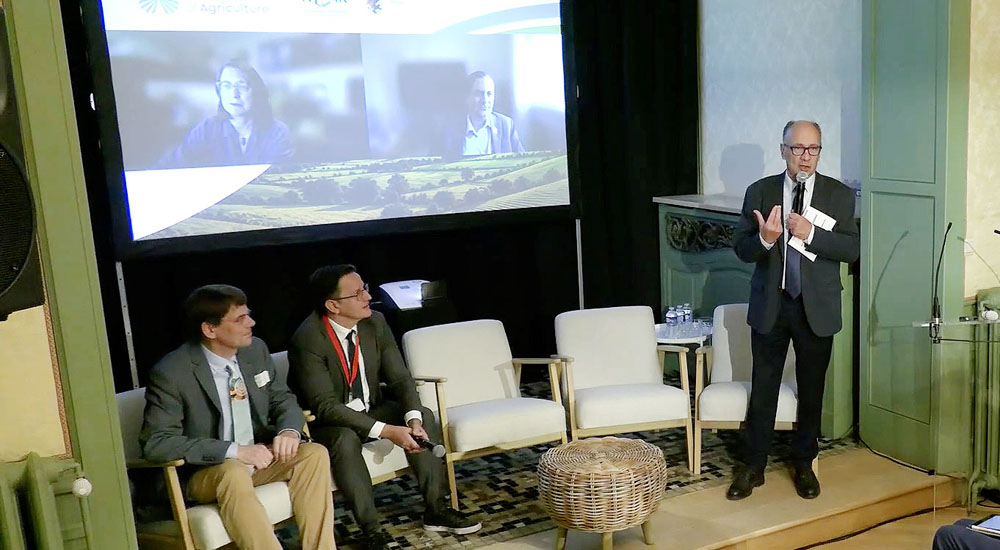
Hubertus Gay, Deputy Head at the Agro-Food Trade and Markets Division of the OECD, highlighted measuring productivity growth in animal production as a key challenge. This has been “more sluggish than in crops”. Overall, it was unclear whether demand growth or productivity growth was slowing down faster, he pointed out. Tassos Haniotis underlined this was a central concern of the FAO and wondered how this would affect vulnerable producers.
David Laborde responded by underscoring the FAO’s desire to protect low-income countries that, without productivity gains, would suffer as more efficient world markets force prices down. Diversifying farmer income was one solution, he noted.
Katie McRobert explained that exporting up to 70 percent of its produce has not increased food prices in Australia. Deregulation, however, boosted productivity gains in the farming sector in the early days. The removal of farming incentives and subsidies, although painful, has restructured the sector, changed views on productivity, and strengthened supply.
Growth and the CAP in the EU
Large differences in productivity growth exist on macro and micro levels in the EU – between member states and even between regions within states, noted Bence Toth. The Common Agricultural Policy (CAP) allows states to interpret and implement it according to their own strategic goals but the way each market functions and the value they generate varies widely. The main driver of EU farming productivity, for some time, has been labour. This is currently undergoing a restructuring. “We have nine million farms in the EU; six million beneficiaries of the CAP, and less than four million market-oriented,” he pointed out, adding, “so here we have an issue of internal liability, resilience.”
The question, he said, was: when EU farmers make less than half the average wage do we want more farmers or to take them on a different path? On the policy side, he underlined the need for minimal disruption to ensure the welfare of citizens. There was a need for more scenario planning taking into account different geopolitical futures and using assumptions to draw implications for macroeconomic trade. With current price volatility, the implications of policies on price development would also be important.
Measuring risk
Resilience measures, in response to climate change, will be vital to global food security. Is it possible to quantify the risks associated with climate change? Is there an appetite among institutions to measure and mitigate these risks?
David Laborde outlined uncertainty over both questions but raised the prospect of private sector interest. A public-private partnership, motivated by strategic thinking and pricing risk, holds real potential and interest, he pointed out. The only question would be how to mobilize resources.
Hubertus Gay underscored several challenges. He pointed out that policymakers often sideline long-term planning in favour of short-term goals. Parts of the private sector might also be unwilling to forego short-term profitability in favour of profits decades in the future, though he believed some industries would invest.
Ms McRobert underlined a long-term challenge in creating policy to navigate risk: a lack of agreement over collaboration, data sharing and leadership. With a clear picture of the risks to farming already available, she said: “I would say that the best person to manage and understand those risks is the farmer herself or himself. If they understand the risks, they will adapt to them.”
Closing the session, Mark Titterington, Co-founder and member of the Advisory Council at the Forum for the Future of Agriculture, conceded that forecasting risk is challenging. Highlighting the pandemic, a member state exiting the EU and conflict over the Strait of Hormuz, he called for better risk assessment measures and greater investment in crisis prevention.
Session 2 – What if? Three scenarios for EU agriculture
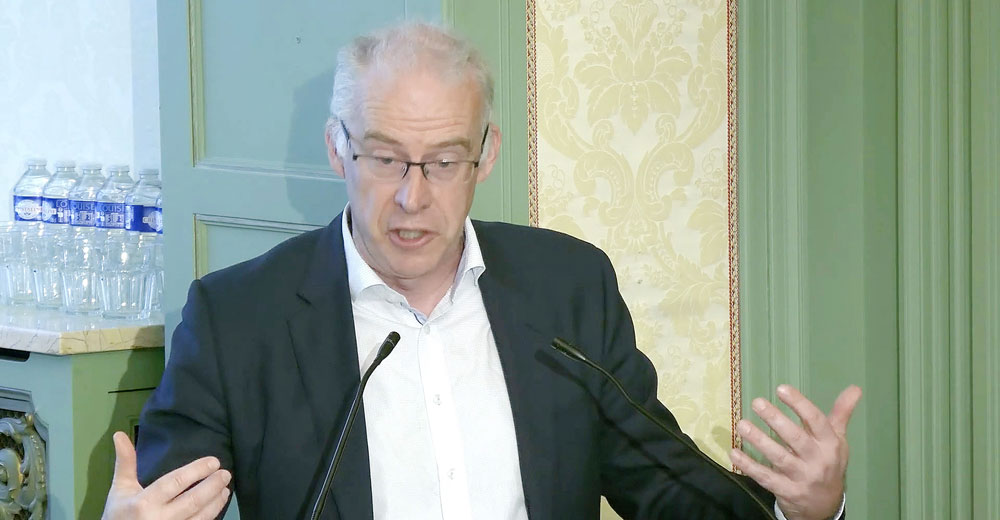
The second session opened with Erik Mathijs, Director of the Sustainable Food Economies Research Group (SFERE) and Professor of the Faculty of Bioscience Engineering at KU Lueven, who described how at Leuven they teamed up with a private partner, who has large panel data sets based on data from 2,000 farms over five years, to get some observational evidence on what are actually the risk-reducing measures that work or that don’t work. On the lack of available data, held mostly in private hands and protected by GDPR, Prof. Mathijs said, “we need this private-public collaboration to have access to the data that is out there.”
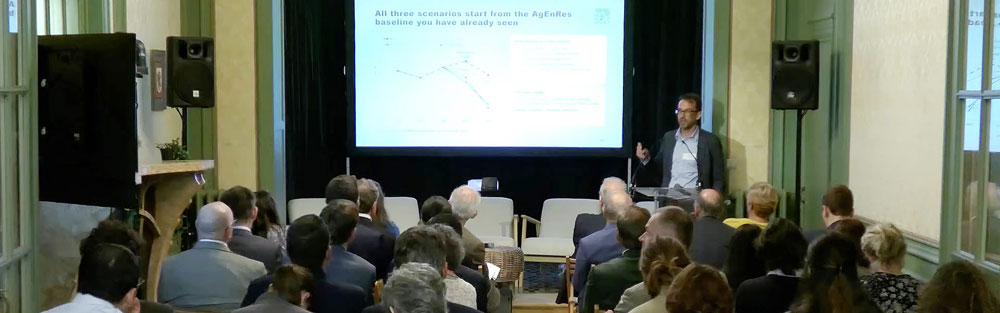
Erik was followed by Tamas Krisztin, Senior Research Scholar, Integrated Biosphere Futures Research Group, IIASA Biodiversity and Natural Resources Program, presenting three scenarios. They track the potential effects of types of energy shock on food production in the EU. These included:
- a one-time, transient energy price spike
- a persistent, structural shift where elevated prices remain high
- an escalating shock, worsening energy prices with a stronger increase.
Falls in output ranged from 4% to 19% in the models, with wheat and potatoes most acutely affected. Land abandonment towards 2040 might also be a notable trend.
Perspectives from the panel
Reflecting on the scenarios, Giampiero Genovese, the Head of Unit for the Economics of Food Systems at the European Commission, agreed with Mr Mathijs that the lack of data availability added to complexity in developing models. He suggested that interoperability of different datasets meant artificial intelligence (AI) could help overcome this challenge. Although, he pointed out that trials of AI running in parallel with current studies have raised quality concerns. AI model results require human validation.
Land use
Katalin Balázs, Manager, Possessio, raised questions around a temporary price shock leading to land leaving production. “If agricultural prices increase only modestly, because imports limit the price response, farmers carry much of the adjustments,” she pointed out. She advised the protection of production and food security required serious investment, not just compensation for farmers.
New technologies could change the underlying economics but trade policy and input markets should also be in scope. Trade-offs would be required and, when it comes to changing land use, farm incomes, food security and imports should be considered, as well as examining the value to society of different land use.
Sophie Hélaine, Head of Unit Policy Performance at DG AGRI, at the European Commission, pointed out that the models could help improve policy preparedness. Trust is critical and AI models, at present, are not sufficiently transparent to be translated into policy measures.
Ms Hélaine called for models with foresight that also highlight who will be most affected. Current high fertilizer prices have most affected intermediate farmers and crisis measures need to target those most in need. Food price inflation is rising up the agenda at policy level and strategic stock levels could moderate policy responses.
Farm resilience and innovation
Saskia Visser, Director of Strategic Partnerships & Opportunity Development at Climate-KIC, stressed systems transformation should be considered a response to shock. Taking her experience of elevating 40,000 African farmers out of food aid in two years, she believed models should focus not just on efficiency impacts but also on farm-level risk responses and resilience.
Mr Genovese agreed this was important and highlighted current work to collect innovation and transformation data, including in soil regeneration and human capital. The goal is to assess its impact at farm level and help improve farm resilience.
Ms Visser pointed out that a lack of infrastructure limits adoption of innovation at scale. This would improve with validation across different farming sectors, investment in capabilities and training, business models that create value, and dialogue to build trust. This effort would require collaboration between private and public bodies and farmers.
The EU, Ms Hélaine, pointed out, has launched a transition plan in the CAP proposal post-2028 to fund farmers to meet climate and environmental challenges.
Availability of farm data
To close the session, the panel discussed how availability of farm data would increase potential investment from banks willing to fund farm resilience interventions. The dairy sector is a leader in data collection. Ms Hélaine pointed out that the European Commission is currently working on a facility where farmers could share data and consent to data sharing with different parties.
Session 3 – Prospects and challenges for sustainable productivity growth
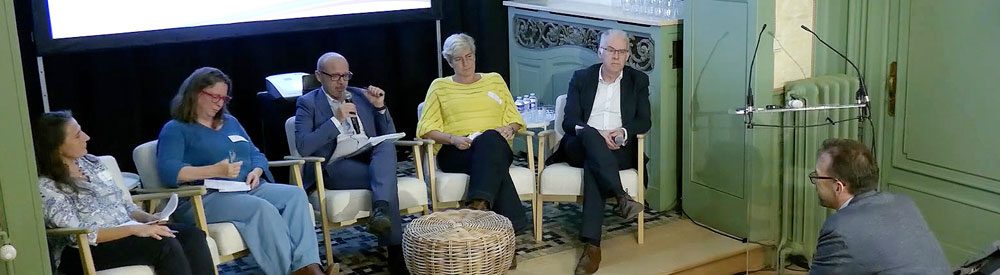
The sustainable productivity growth session began with Koen Dillon, Head of Unit at the European Commission, Analysis & Outlook, asking how to define and measure sustainable productivity. He argued TFP (Total Factor Productivity) indicators are useful but limited. Sustainability measures, such as soil health and weather effects, for example, are not included. He stressed that environmental performance and productivity do not always go hand-in-hand before also pointing out that “resilience is something different.”
He suggested assessing how productivity is changing as a first step. Then:
- Developing environmental or sustainable productivity measures
- Complementing productivity analysis with resilience indicators
- Looking at farm, region and farm-type levels
- Working on explicit causal links.
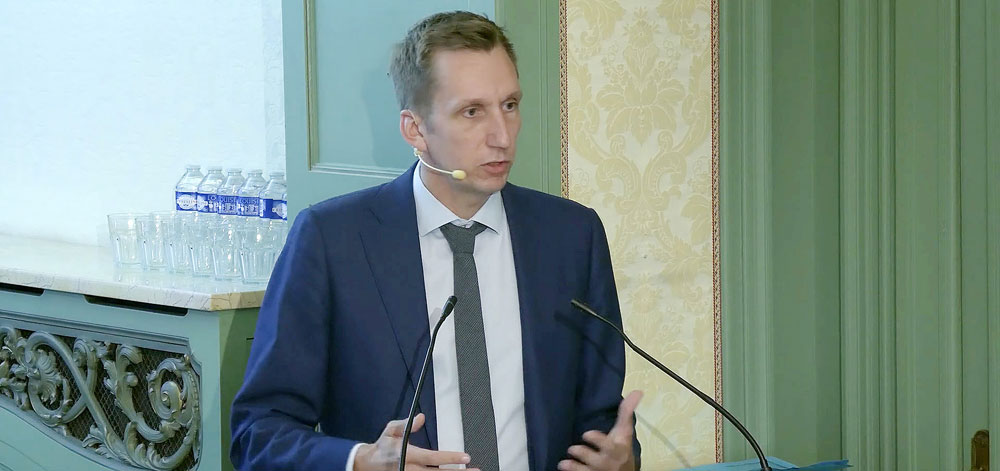
Chellie Maples, Agricultural Economist and Senior Research Manager at the Global Agricultural Productivity (GAP) at Virginia Tech University, examined the link between TFP and payments for environmental practice implementation in the EU, including decoupling payments. No consistent relationship was found in its annual GAP report. She pointed out that linking TFP growth to policy was a “difficult nut to crack” but important in understanding how to encourage certain practices.
Underlining the risks to agricultural food production, John Baffes, Senior Agricultural Economist in the Development Economics Prospects Group at The World Bank, pointed out that commodity prices are expected to rise, particularly agricultural commodities.
He outlined four risks creating challenges to productivity growth:
- Energy market instability, beyond oil and natural gas, that is likely to persist
- Higher energy prices and potential diversion of vegetable oil to diesel production
- Higher borrowing costs fuelled by inflation raising the cost of production
- El Niño, which has already started, with further effects expected.
“The big issue now is what happens if those risks materialize at the same time,” he said.
Perspectives from the panel
David Laborde of the FAO raised concerns about the relevance of productivity measurements. He pointed out that moving from an extractive system to a regenerative one means that by not measuring the ways we have undermined natural capital, such as soil and water, we have lived in an “illusion of productivity”. He suggested a green-TFP would measure sustainable productivity, resulting in a more accurate measure.
Marek Różniak, an entrepreneur, farmer and President of Mzuri World, described the need to increase productivity using technology. This required farm restructuring, with fewer small farms. The average farm in Europe is 70 hectares. In Argentina, the average farm is 600 hectares. He explained that small farms struggle to implement innovation.
Mr Laborde agreed farm sizes need to increase but that mechanization of small-scale farms through drone technology and using AI to deliver extension services could reduce the cost of some services for small farms.
Tassos Haniotis argued that productivity incentives for small farms could be created with large farms operating as models. He highlighted soil health as the key to productivity gains. Here, the issue was data: private companies collect enormous volumes of data. He called for a debate around making aggregated data on soil health available in a way that delivers a public good and protects the privacy of farmers’ economic data.
The data does exist, argued Ms Maples, the challenge lies in bringing it together in a usable format.
Mr Laborde agreed that data on soil health was reliable; water data was available in some areas; but biodiversity data is highly complex and relating it to productivity even more so. He called for agreement on what to measure, then standardization of data to make it interoperable, particularly between public and private spheres. He also stressed that what is measured would have cost implications and that he believed farmers should gain value from the data, rather than paying for its collection and again for using it.
Mr Baffes highlighted rising costs, licensing and copyright of data owned by private companies as barriers to data access.
Wrap-up
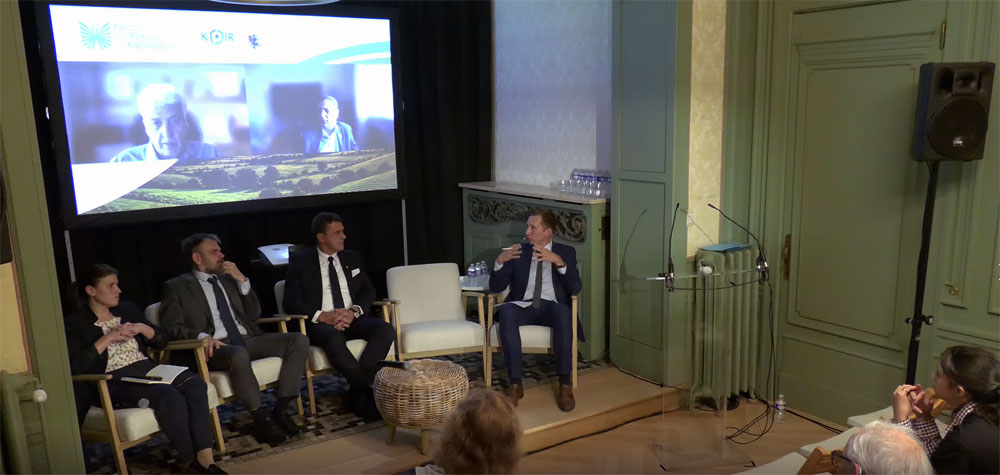
In closing, Koen Dillon said transparency in land use and land transfers will be a key driver in sustainable productivity growth. Several key themes emerged in the discussion:
- The need to harmonize data, leverage existing data to answer more questions and improve robustness in models
- International institutions need to adjust to shocks to avoid poor decisions
- Greater investment in land as a finite resource.
- Policy design should pilot outcomes-based payments because practices translate into different outcomes by crop, location and other variables.
The panel concluded the final custodian of the land is government and regulation to support farmers and landowners was critical to future food security.
Looking Ahead: Markets, Agriculture and Policy
Day 2 of the Forum for the Future of Agriculture 2026 Market Outlook workshop built on Day 1 by examining the environmental and policy implications of the newest OECD-FAO Agricultural Outlook, covering 2025-2034. Day 1 had assessed the uncertainties in world markets, examined the policy implications and what it means for agricultural markets and sustainable productivity growth in the decade ahead.
Opening day 2, Tassos Haniotis, Special Advisor for Sustainable Productivity at the Forum for the Future of Agriculture and Senior Guest Research Scholar, IIASA, recapped Day 1. He pointed out the first session was a typical presentation of the newest OECD-FAO Agricultural Outlook but the rest were unusual for addressing so many uncertainties. He remarked, “These types of uncertainties and their extent are something that really surprises the more you look at it.” He suggested the productivity debate should focus on something not covered in the models, namely the unique dependence of EU agriculture on fertilizer prices, and the fact data is abundant “but all over the place”.
Session 1- Data needs and opportunities
The second part of the workshop opened with a presentation on data and was followed by a panel discussion.
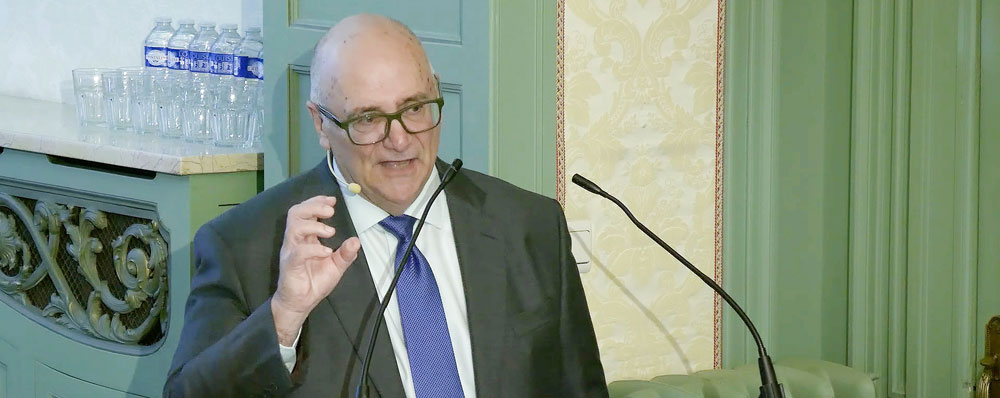
In his presentation, Spiro Stefanou, Professor Emeritus of Agricultural Economics at Pennsylvania State University and former Acting Deputy Undersecretary for Research, Education and Economics at the USDA, described the role of the Economic Research Service (ERS) at the USDA as researching emerging issues and anticipating trends. The USA has 13 federal statistic agencies rather than a single national office. The advantage is the depth of subject matter expertise available.
Mr Stefanou began by unpacking what data is and highlighting how it can be ambiguous depending on who is interpreting it. He stressed that as a public good, data is the basis for evidence-based policymaking but that bad data leads to its opposite: misinformed policymaking. Interpretation is key. Herein lies a challenge: expert judgment is not currently being released alongside data, undermining confidence and trust in it. The data ecosystem is also becoming increasingly decentralized and privatized. The collision of private and public data sets, released on social media, via variety of sources, is blurring the data ecosystem. Simultaneously, as proprietary providers consolidate, “they are pushing up the prices of data”. Mr Stefanou stressed the value of data depends on trust in the institutions that produce, curate and communicate it. Trust, he pointed out, is eroding. “We need to think about how that spills over into the data that we have. And those data can lose influence.”
Mr Stefanou concluded by describing a US statistical system under “severe stress” after 15 years of declining budgets, a loss of a quarter of ERS staff in the first year of the current administration and a 40 percent cut in staff at the USDA’s National Agricultural Statistics Service. With data collection costs rising, the ERS has called on private companies to “fill in”. This has led to transparency issues and concerns among farmers over how data will be used – particularly in terms of privacy and re-identification. This is driving to a decline in survey participation. He said farmers are wondering: can you guarantee my privacy here?
Panel reflections: reducing farmer burden, preserving quality, interoperability
Emanuele Paolo Sicuro, Policy Officer for DG CLIMA at the European Commission, immediately reflected on what he had learned and raised a concern. He remarked the idea that European agriculture was returning to an input-driven growth model was unfeasible. His organization has developed a tool to monetize carbon removals and soil emissions reduction to create opportunities for farmers during the climate transition. He reflected that the discussions at the workshop implied a need to accelerate development of these tools.
Carlos Aragones, Director of Production Systems at John Deere, argued the ability to increase productivity with the same inputs or fewer was about better decision-making, which depended on robust data. He echoed views that collecting data was key but building trust with farmers who share the data and returning value to them was equally critical.
Reducing burdens for farmers
For Koen Mondelaers, Deputy Head of Unit, DG Agriculture and Rural Development at the European Commission, the most pressing challenge within Europe is the need for simplification. “The message is very clear. Farmers were protesting on the streets. We need to live up to the 35 percent reduction in administrative burden.”
He suggested the solution is two-fold: reduce frequency of collection and the number of variables. But, he argued, stretching frequency to five years would harm policy evaluation. The EC is investing in digitalization and interoperability with a view to introducing a unique Farm ID to connect the data. Interconnection also brings risks, he pointed out. Putting the farmer in control of what can be shared is also under consideration to preserve trust.
Preserving quality
Across the panel there was broad agreement that data needs to be robust, independent, transparent, trustworthy and of high quality.
Alain-Dominique Quintart, Head of Government & Public Affairs Europe at Syngenta, explained this was why his organization is collecting its own data. With 185,000 trials over 10 years, the data collected has been calibrated to build models capable of delivering accurate advice to farmers across multiple variables, from weather and soil to cropping patterns and sowing density. “These have a direct impact on productivity,” he pointed out.
Interoperability
Simone Sala, Executive Director at non-profit the Varda Foundation, believed the seeming divide between private and public ownership of data could be overcome with a third solution: a “neutral shared data infrastructure” model. It would be complementary to the public-private one. Varda has built a soil data platform, which is open source, and a field ID field identifier. He stressed, “You need federation to scale and you need harmonization to have data that becomes comparable.” The model unlocks value for both public and private users, he argued.
Mr Mondelaers observed that the EC is responding to some of the data challenges being highlighted. One of them is the concept of “data spaces”; a federated data space built on use cases. A marketplace for data, it enables data owners to sell it to interested parties. Through the concept of a ‘business wallet’, farmers store data on, for example, soil health. This data could also be used by farmers to demonstrate adherence to sustainability targets and apply for future eco schemes. He said a layered access approach is under consideration.
Mr Quintart said Syngenta would welcome discussions about data on soil, for example, but would “insist on the quality of the data”.
On quality and interoperability of data, Mr Sicuro observed that with the 2024 Carbon Removal and Carbon Farming Regulation, DG CLIMA is seeking to introduce a registry of schemes currently being tracked. Interoperability of existing certification schemes will help build trust and measure farmer adoption of sustainable agricultural practices, enabling member states to capture improvements and achieve national targets.
Session 2 – How to use the wealth of information to promote the sustainable productivity
A presentation by Ricard Ramon, Head of Unit, Policy Perspectives for DG AGRI at the European Commission, framed the opportunity to promote sustainable productivity growth through data as a governance issue. The data is already there but must be better organized and coordinated.
With the new Common Agricultural Policy (CAP) under negotiation, Mr Ramon could not discuss details but offered several certainties. Instruments such as direct payments, voluntary environmental schemes, investments and area-based decoupled support until 2034 were secure. However, a new, flexible approach, he believed, would stimulate member states and farmers to “make the most of the new model” by adapting it to specific local realities. The process was, he argued, “on the right track”.
One “important novelty” was a new transition payment. It would reward farmers with clear projects with a lump sum without the need to undergo cumbersome agro-environmental bureaucracy. He hoped members states would use this in an “intelligent way”. He also called for a “food chain approach” to sustainability schemes, involving not just farmers but also retailers. He reflected, “The reality of sustainability is not driven anymore by our regulatory requirements; it’s driven by the market”. Better governance to help farmers manage this process would be vital, he remarked.
There is now general agreement at DG AGRI that data in four areas (soil, climate, biodiversity and water) should form the bulk of certification schemes. He emphasised agreement is not yet final but is required across the whole food chain.
The issue of land would be a core goal in the year ahead. The creation of a Land Observatory to improve market clarity will examine investment patterns, land abandonment, land use and other parameters. A Sustainability Compass initiative was also underway to manage fragmentation of certification across member states.
All of this information, concluded Mr Ramon, would help promote sustainable productivity.
Panel reflections: banking and finance, simplifying data, optimism
Mark Titterington, from the Forum for the Future of Agriculture, began the final panel by introducing the first speaker and asking him to address the issue of how to use the wealth of information to promote sustainable productivity.
Barry Cowen, Member of the European Parliament, gave a perspective from the European Parliament about to negotiate the CAP. He described a restricted financial reality as a result of defence and security commitments, operating within an “ancient” structure, but with an obligation to be innovative and agile. He outlined various possible outcomes of the negotiations. “I’m coming around to supporting the new architecture,” he said, arguing it allows for increased food production to meet global demand sustainably; primarily in larger, intensive, productive holdings. He called for new rewards for smallholders for rewetting, carbon trading, biodiversity gain, genetics for suckler herds, and so on, to supplement incomes and avoid depopulation.
Banking and finance
In response to a question from Mark, Mr Cowen said he believed data and technology could improve financial outcomes for farmers. He argued that financial institutions are recognizing the value of climate mitigation measures and that an agricultural system that delivers a common public good requires whole value chain support, including financial intuitions. He hoped member states would compel the private sector in their regions to provide support.
Mr Cowen’s final point was that member states should “give dignity to those that leave the land”, ushering in a younger generation of farmers more in tune with new technology and farm practices, which would also deliver greater sustainable productivity.
Peter Frölich, CEO AgriPurpose AG and Co-founder of the European Alliance for Regenerative Agriculture (EARA), agreed that value chain support could deliver real gains in sustainable productivity. He underlined that, “If you have good access to money, debt restructuring, preferred interest rates, then it’s all about retail also having the right rules so that we can capture more value at the consumer level.”
The panel agreed that data should return value to the farmer. Peter’s message was firm: “If there’s no benefit for the farmer, then let’s ask the question: why do we need that data in the first place?”
Mark wondered if financial institutions understood “the language of data”. Mr Frölich responded that the data could be reduced to its simplest form “inputs versus outputs… the most solid data from farms is actually through the normal accounting toolkit.”
Is data abundance complicating the picture?
Mark steered the discussion towards what appeared to be emerging: a consensus that perhaps abundance of data was over-complicating the situation.
Mr Frölich offered a rule to avoid this: “When you put the new rule or new data point to be captured [in place], think of five old ones to scratch.”
François Kayitakire, Head of Food Security Unit at the European Commission Joint Research Centre (JRC), broadly agreed the proliferation of data adds complexity. The JRC has built an evidence library on farming practices in response. By synthesizing and simplifying published findings, “That’s one way of actually getting all this data into the policy-making process but also back to the farmers to make their own decisions,” he said, pointing out AI could also summarize large volumes of data.
Such data abundance is a luxury not available in Africa, Leonard Mizzi, Adviser Food Systems at the Directorate-General for International Partnerships, pointed out. He argued “data is a global public good”, warning: “If the global public good is slashed, if the multilateral system slashes on global public goods, then we only give a role to the private sector, which becomes transactional.”
He outlined the importance of the UN’s Sustainable Development Goals (SDGs) and said: “We are clearly off track on most SDGs. We know that. And we need data.” The big challenge, he stressed, was using data to create “bankable solutions” that anticipate acute food hunger.
Reasons for optimism
Asked for optimistic reflections, Mr Cowen said he believed the CAP negotiations would reach compromise. Under a common good obligation, the EU would ensure relevant data sharing with those most in need.
Mr Francois reflected that with plenty of data and the capacity to analyze it, the JRC has “the capacity to have well-informed policy”. He also saw some countries providing data in food crisis hotspots and had faith that “society is quite resilient”.
Mr Frölich agreed and with a positive paper from the European Alliance measuring agricultural outcomes just published, he believed many farmers are innovative and capable of meeting the challenges ahead.
Mark closed the workshop reflecting that, “for the first time we are starting to have the right conversations about how we use the policy framework and the policy tools”. He was convinced that public and private money was available. Coupled with data and the right technology, this would unlock better farming outcomes in both the Global North and the Global South.
All the original recordings from the ‘Market outlook workshop’ are available on demand by clicking the links below.